
How to Double Your Performance Using The 12-Week Year

Discover how to double your performance using The 12-Week Year framework. Learn the six-step system—from Vision to Scorecard to compressed execution cycles—that turns ambitious professionals into top 5% performers without working more hours.
How to combine the 12-week year and personal strategy to achieve top 5% performance

When you combine a unique personal strategy and an elite execution system like the 12-week year, you can break into the top 5% of your field or profession.
How to Get More Done in 3 Hours Using The 12-Week Year
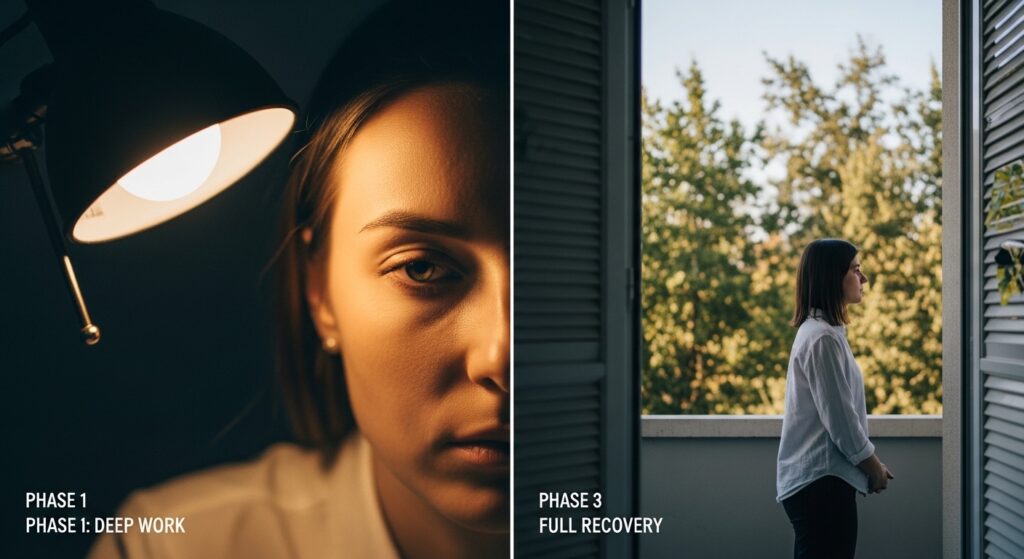
Most professionals treat deep work as a time problem — block more hours, grind harder, push through. But research shows that output quality drops sharply after 60–90 minutes of sustained cognitive effort. The Deep Work Cycle flips the script: cycle between high-energy work and full recovery, twice per day, and integrate it into The 12-Week Year execution system to make elite-level output repeatable every single week. Here’s the exact framework.
How to Identify and Upgrade Your Career Bottleneck with The 12-Week Year

Learn how to identify which professional skill to upgrade and systematically improve it using The 12 Week Year framework. This step-by-step process uses bottleneck analysis, lead indicators, and 12-week execution cycles to compound skill development for long-term career impact.
How to Best Manage Your Time with the 12-Week Year

Discover how top performers use The 12 Week Year to manage all 168 hours of their week. Learn the four-step time audit and deliberate week-design process—mapped to the five pillars of the 12-Week Breakthrough system—that turns wasted hours into measurable execution.
The core 8 principles of the 12-Week Year

After 15 years of studying what separates top 5% performers from everyone else, I’ve identified 8 foundational principles that appear in every serious performance system. This article breaks down each principle and shows exactly how The 12-Week Year framework — and my enhanced 12-Week Breakthrough system — operationalizes all eight into a single, integrated execution operating system. If you’ve been applying productivity advice in fragments, this is the piece that connects the dots.
How to Prioritize Your Week With The 12-Week Year
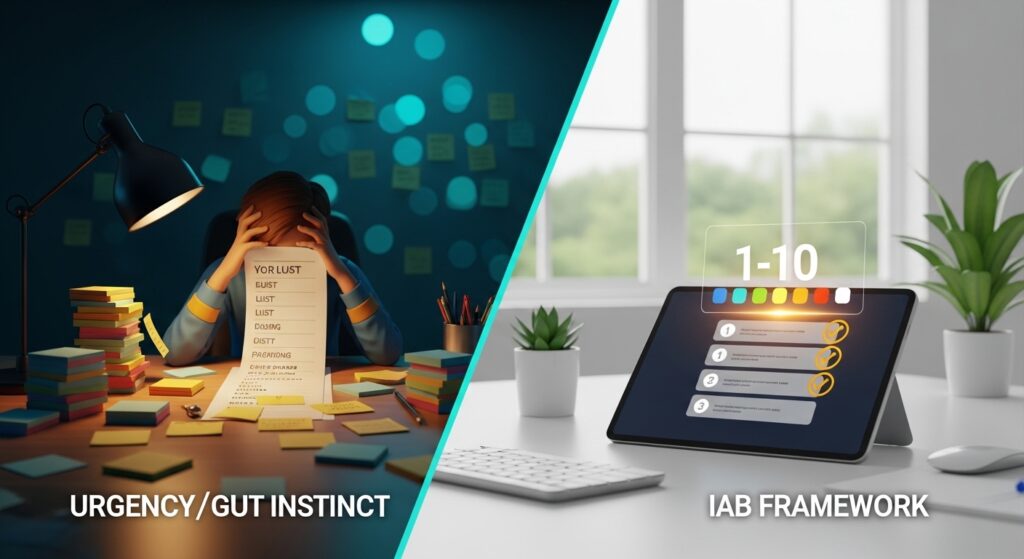
Most professionals prioritize their week using urgency or gut instinct—and wonder why the important work never moves. The IAB Scoring Framework (Impact, Amplification, Bottleneck Removal) replaces guesswork with a repeatable method for identifying the 3–5 tasks that actually drive your 12-week goals forward. Learn the exact weekly prioritization process used inside the 12-Week Breakthrough execution system.
The 12-Week Year and The State of Flow

Flow state makes professionals 5x more productive — yet most access it less than 10% of the time. This article breaks down the neuroscience and psychology of flow, the three conditions required to enter it deliberately, and exactly how the 12-Week Year and the 12-Week Breakthrough system engineer those conditions through five execution pillars: Vision, Goal Architecture, Execution Engine, Weekly Operating Rhythm, and Measurement. If you want peak performance by design — not by accident — this is the framework that makes it possible.
The Digital Tools I Use With The 12-Week Year

Most professionals collect productivity tools the way people collect gym memberships — lots of sign-ups, very little results. The real question isn’t which tools are best. It’s which tools serve a system. In this post, execution coach Dan Mintz breaks down the exact software stack he uses daily to run the 12-Week Breakthrough — a structured execution system built on five core pillars: Vision, Goals, Execution, Time Use, and Measurement. You’ll see how each tool earns its place by serving a specific function in the system, not because it’s trending on Product Hunt.
How to complete complex, long-term projects with the 12-week year

The 12-week year, which enables clear tracking and performance evaluation, is an ideal performance system for completing successfully complex long-term projects.
How to Measure Your Performance With The 12-Week Year

Measuring performance in the knowledge economy is complex and multidimensional. This article tackles this issue and explains how to do it using the 12th week year as a productivity system.
The 12-Week Year vs OKRs: A Practitioner’s Deep Comparison 2026
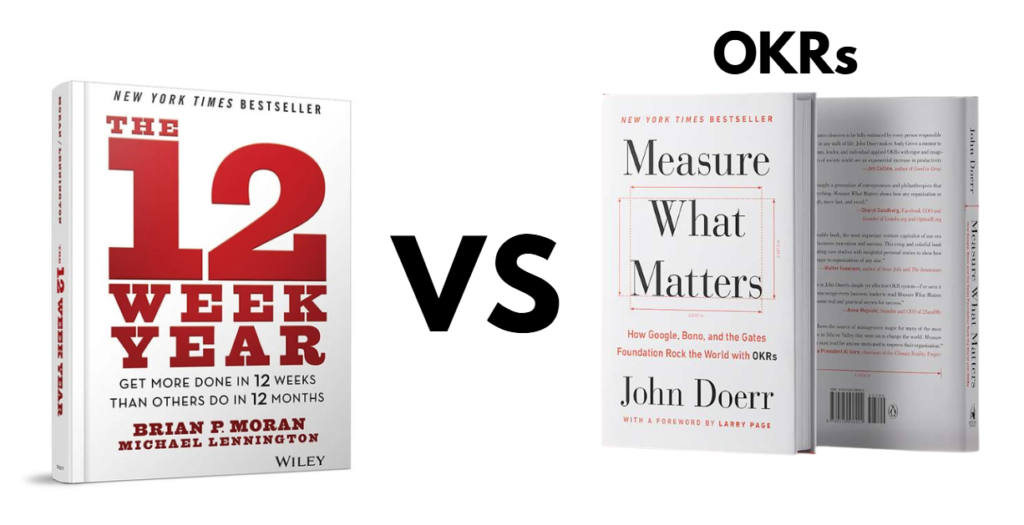
Choosing between OKRs and the 12-Week Year isn’t about which system is “better”—it’s about which problem you’re solving. The 12-Week Year excels as a complete execution operating system for individuals and small teams (1-5 people) who struggle with the planning-execution gap, providing prescriptive discipline through lead action tracking, calendar blocking, and weekly scorecards. OKRs excel as an organizational alignment framework for coordinating teams (5-100+ people) who need transparency to prevent siloed work, using public goals and outcome-focused measurement to create coordination without bureaucracy. Both reject annual planning in favor of quarterly cycles with weekly rhythms, but 12-Week Year solves individual execution discipline while OKRs solve team coordination—and for teams of 5-15 people, combining both (OKRs for alignment, 12-Week Year mechanics for execution) often produces the best results.
Why Is a Year just 12-Weeks in The 12-Week Year

Most professionals fail to execute annual plans—not from lack of discipline, but because 12-month horizons create structural execution failure. Discover why the 12 Week Year system compresses time to where humans actually perform, and how short cycles with fast feedback transform goals into results.
How Sam Transformed His Business – And What It Reveals About The 12-Week Year

In his transformative book “Work the System,” Sam Carpenter documents one of the most dramatic business transformations I’ve encountered in my decade of implementation work. After 15 years of 80-hour weeks and operational chaos, Carpenter discovered a simple truth: his business wasn’t chaotic—it was composed of unmanaged systems producing unintended results. Within days of this breakthrough, he created three documents that would revolutionize his business: a Strategic Objective defining his purpose, Operating Principles guiding decisions, and Working Procedures documenting execution. The results were immediate. Within six months, his workweek dropped from 80 to 60 hours. Six months later, below 40. Within two years, he’d acquired three competitors and grown from 300 to 700 clients. Today, he spends two hours per week on his business.
This story matters because it reveals why the 12-Week Year works: it provides the exact three-part system Carpenter discovered, purpose-built for individual professionals. Through my work guiding over 50 knowledge workers through systematic 12-Week Year transformations, I’ve witnessed the same pattern across every industry: professionals struggling with execution don’t lack capability or motivation—they lack systematic infrastructure. You are operating a one-person business unit. And like Carpenter, you probably lack the systematic infrastructure that prevents chaos. Discover how to build Sam’s three-part system—Strategic Objective, Operating Principles, and Working Procedures—through the 12-Week Year framework, and transform from reactive firefighting to systematic execution.
Overcoming Inconsistency With The 12-Week Year
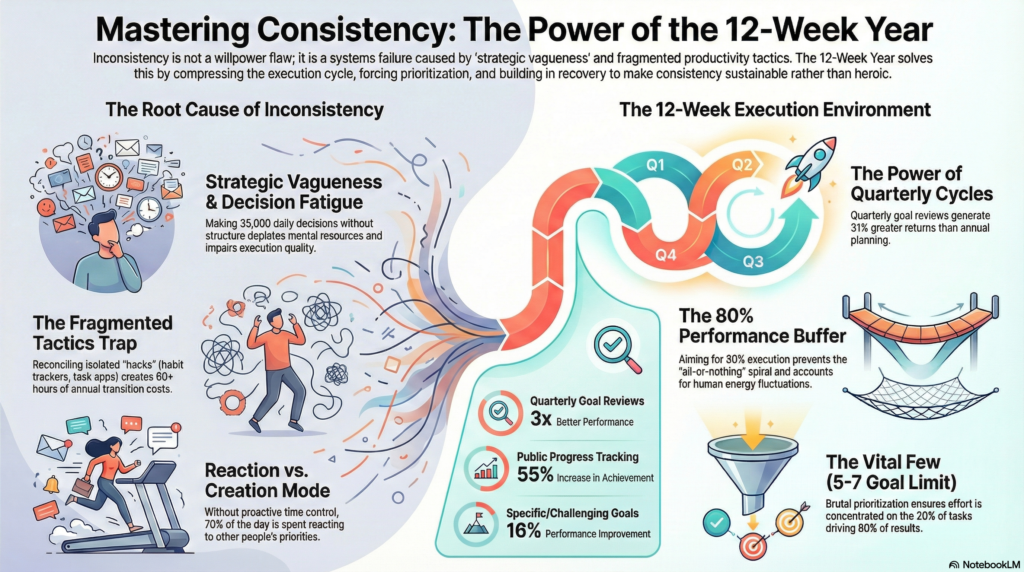
Most people blame discipline for inconsistency. The real problem? Strategic vagueness. Learn how the 12-Week Year creates a complete execution system that eliminates decision fatigue, forces focus, and makes consistency sustainable.
The Definitive Guide to Choosing the Right Goals with the 12-Week Year

Most people don’t fail because they lack discipline. They fail because they choose the wrong goals. This article breaks down a research-backed goal selection process inside the 12-Week Year—showing how to identify the few goals that actually drive results, instead of staying busy with low-impact work.
How the 12-Week Year Helped Marcus Escape Productivity Overwhelm

Marcus tried time-blocking, GTD, and AI tools—but stayed overwhelmed. This case study shows how the 12-Week Year restored focus, clarity, and execution.
A Guide to How the 12-Week Year Addresses Overwhelm, Procrastination, and Inconsistent Execution — at Work and in Life

Many capable people feel overwhelmed, unfocused, or inconsistent not because something is wrong with them, but because the way they’re trying to manage work and life no longer fits the reality they’re living in. Over time, long planning horizons, competing priorities, and vague goals quietly erode clarity and momentum.
This guide explores those patterns from the inside out. It doesn’t promise quick fixes or motivation tricks. Instead, it explains why these struggles are so common — and how the 12-Week Year helps people regain focus, consistency, and trust in themselves by changing the structure around execution.
If you’ve ever felt busy but unsatisfied, committed but scattered, or capable yet stuck, this page is designed to help you make sense of that experience — and show you a clearer path forward.
We Tested The Best Physical Planners for the 12-Week Year (Updated for 2026)

The 12-Week Year requires a certain kind of physical planner. We tested the best of them.
This list is for people running—or trying to run—the 12-Week Year, and who want a planner that actually helps them execute week after week. Some of these planners are built specifically for the 12-Week Year. Others aren’t—but work surprisingly well once you use them the right way.
We’ve used all of these in real life. Some stuck. Some annoyed us. Some needed adjustments.
These are the six that earned their place.
12-Week Year Tools, Templates & Planners: The Definitive Guide

The ultimate 2026 guide to the tools, templates, planners and apps for the 12-Week Year.
I Tested the Most Popular Personal Productivity Systems for 15 Years. Here’s What Works.

Most productivity systems promise focus, clarity, or motivation. Very few survive long-term use, bad weeks, and real life outside of work. After testing productivity systems for over 15 years, this article compares GTD, The 12 Week Year, Eat That Frog, Bullet Journal, and Pomodoro using a simple, real-world framework—and explains what actually separates full-stack systems from productivity tactics.
Unlock Productivity with AI and the 12-Week Year

We’re in the semi-co-piloting phase of AI. Learn how this phase changes personal productivity—and why clear structure, short execution cycles, and systems like the 12-Week Year turn AI from overwhelm into real progress.
Long-Term Vision + 12-Week Cycles = The Ultimate Competitive Advantage

Long-term vision is a genuine competitive advantage — but only if you know how to execute it. This article breaks down how high performers connect their 3–5 year vision to daily and weekly actions using the 12-Week Year and the enhanced 12-Week Breakthrough system. Learn how to align meaning, identity, future-self psychology, and short-cycle execution to make your long-term goals inevitable.
Bullet Journaling vs. The 12-Week Year: The Most Complete Comparison for 2026
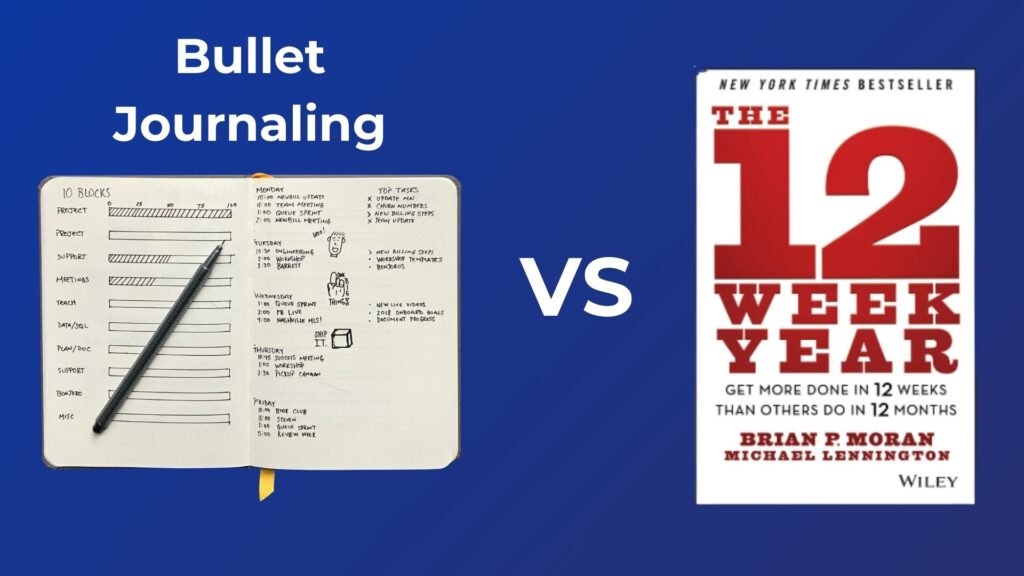
Struggling to choose between Bullet Journaling and the 12-Week Year? This in-depth 2026 comparison breaks down how each productivity system works, their strengths and weaknesses, and which one is better for planning, focus, accountability, and consistent follow-through. Learn the real differences between a flexible analog notebook system and a structured 12-week execution framework — and discover why many people combine the two for better clarity, stronger habits, and faster results. This is the definitive guide to Bullet Journaling vs. the 12-Week Year in 2026.
5 Harsh Truths About Productivity (and Why the 12-Week Year Is the Only Method That Solves Them)

For 25 years, I’ve worked with founders, executives, and high-performing teams. Across industries and roles, the same patterns repeat: people don’t struggle because they lack discipline or motivation — they struggle because the modern environment makes focus nearly impossible. These five harsh truths explain why productivity breaks down, and why the only sustainable solution is a system based on short, focused 12-week execution cycles instead of vague annual goals.
Why McKinsey’s 15-Year Study Proves You Can 10x Your Performance with The 12 Week Year
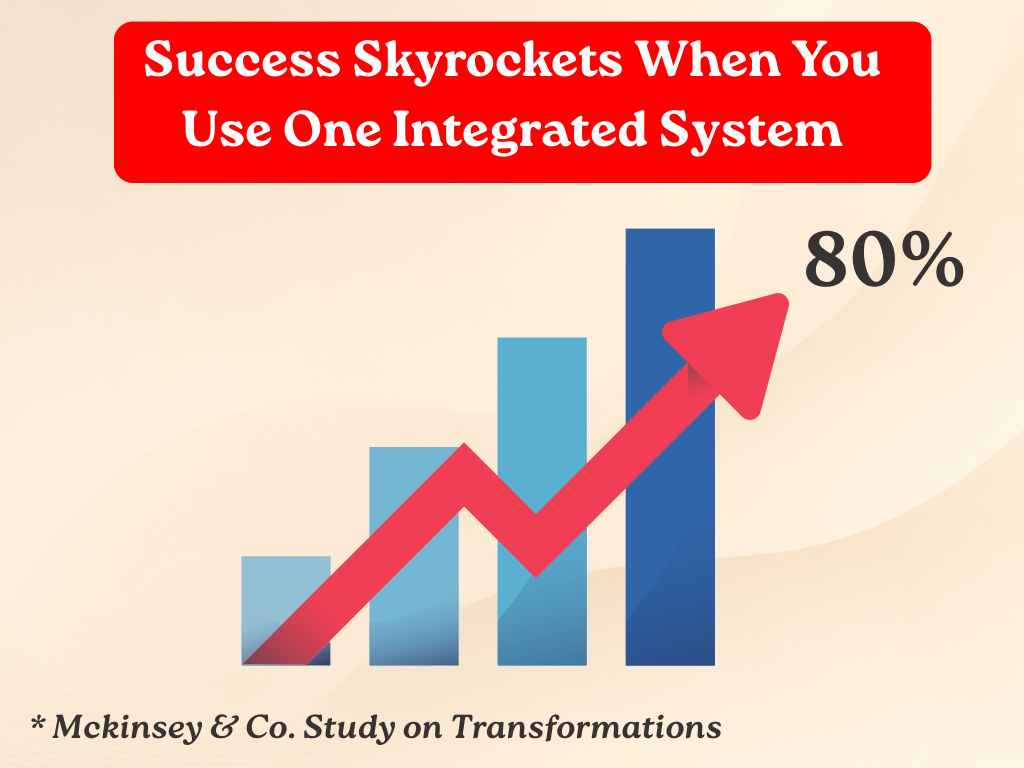
Success skyrockets to nearly 80% when the number of coordinated actions increases inside one integrated system – the 12 week year.
Why the 12-Week Year Must Come Before Skill Building: The Missing Link in High Performance

Most professionals don’t fail because they lack skills—they fail because they lack a system that can consistently transform those skills into results. This article explains why the 12-Week Year must come before skill acquisition, why unstructured learning leads to skill decay, and how a short-cycle execution framework turns knowledge into performance. Through research-backed insights and concrete examples, you’ll see why productivity is the foundation and skills are the accelerators—and why reversing this sequence unlocks your true potential.
Stop Chasing Productivity Hacks: Why the 12-Week Outperforms Everything Else

Most productivity strategies fail for one simple reason: they rely on motivation instead of systems. The 12-week system flips the equation by shrinking your “year” into a focused, urgency-driven execution cycle that eliminates procrastination and turns consistency into something predictable—not accidental. In this article, you’ll learn why 12-week planning outperforms every hack, tool, and yearly goal-setting method, the science behind short execution cycles, and real examples from my own clients who transformed their results by shifting from hacks to a complete integrated system. If you’re tired of starting over, this guide shows you the framework that makes follow-through inevitable.
The Complete 12-Week Year Implementation Guide for 2026
Achieve in 3 months what once took a year with the Complete 12-Week Year Guide for 2025. Set 1-3 SMART goals and boost your productivity today.
12-Week Year vs GTD: Which System Wins in 2026?
The 12-Week Year system enhances productivity by breaking annual goals into 12-week cycles, creating urgency and focus for accelerated achievement. This method emphasizes actionable steps over end results, benefiting individuals prone to procrastination. Users report increased motivation and clearer progress tracking. In 2026, the 12-Week Year outperforms GTD by fostering consistent execution and reducing overwhelm, making it a superior choice for goal accomplishment.
Beat Overwhelm with The 12 Week year

Most professionals today are overwhelmed — not because they lack discipline, but because their work systems are broken.
The 12-Week Year can help solve it.
The Power of Vision: How to 10x Your Results with the 12 Week Year

Most people treat “having a vision” as a nice-to-have — something inspirational, but not practical. Yet the science says otherwise. A clear personal vision, when paired with the 12 Week Year system, becomes the most powerful productivity tool you’ll ever use.
In this post, we’ll explore how meaning (Viktor Frankl), future-self connection (Hal Hershfield), and grit (Angela Duckworth) combine with the 12 Week Year to help you achieve more in 12 weeks than most do in 12 months. You’ll learn how to craft a vision that actually drives behavior, connect emotionally to your future self, and build a simple 12-week execution loop that keeps your goals alive and measurable.
Whether you’re an entrepreneur, professional, or creator — this is your blueprint for turning purpose into progress, and vision into action.
Vision and the 12 Week Year: Inevitable in Achieving Your Goals

Most people don’t fail because they lack discipline — they fail because they lack vision. In this article, you’ll discover why a clear, meaningful vision is the foundation of the 12 Week Year and the driving force behind every goal you set. Drawing on the science of purpose (Frankl), future connection (Hershfield), and grit (Duckworth), this guide reveals how to transform vision from an abstract idea into a practical execution system. Learn how to anchor your goals in meaning, connect with your future self, and use 12-week cycles to turn purpose into measurable progress.
How to Beat Procrastination Using the 12 Week Year (and Digital Minimalism)

Most people don’t procrastinate because they’re lazy — they procrastinate because their system is broken. In this article, you’ll discover how to beat procrastination by combining two powerful frameworks: The 12 Week Year and Digital Minimalism. Learn how shortening your time horizon to 12 weeks and decluttering your digital life can eliminate distraction, create urgency, and help you execute with focus. Featuring real stories, proven science, and actionable steps, this is your guide to turning consistency into your new default setting.
Why the 12 weeks beats a year in the 12 week year
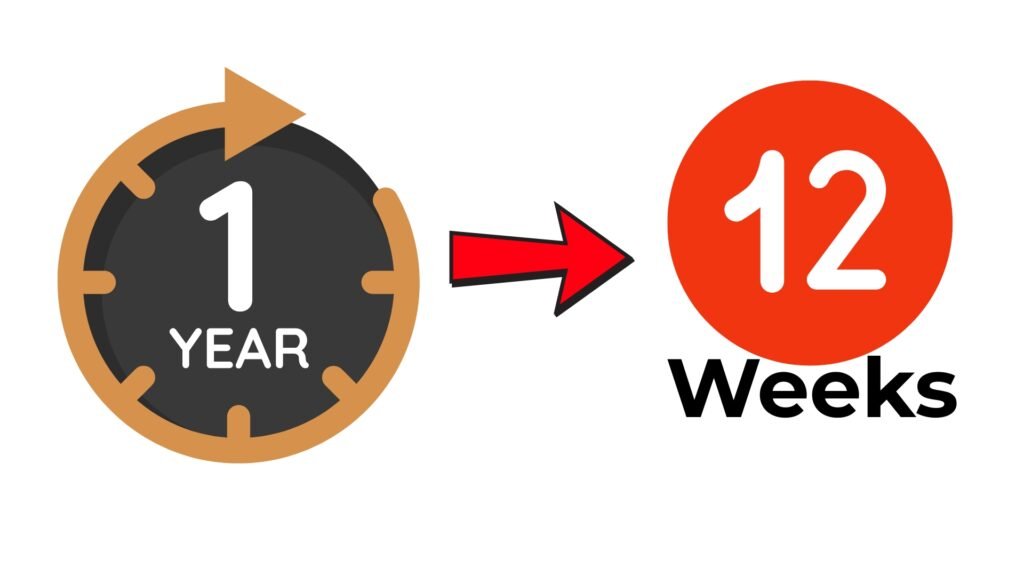
Why 12 Weeks Beats a Year: The Core Idea of the 12 Week Year
We explore the fundamental idea of the 12 week year with is using the timeframe of 12 weeks as a year.
The pros and cons are discussed deeply.
Achieving Your Goals with the 12-Week Year: A Complete Guide
This is the complete guide on how to achieve your goals with the 12-week year productivity system.
The 12 Week Year: What It Is and How It Changed My Life and Work
The 12 Week Year: What It Is and How It Changed My Life and Work.
An in depth guide to what is the 12 week year and how you can start using it nextg week.
From Consuming to Creating: Why the 12 Week Year Is the Missing Link to Achieving Real Freedom

From Consuming to Creating: Why the 12 Week Year Is the Missing Link to Achieving Real Freedom
Master Time Management with the 12 Week Year

How to Master Time Management with the 12 Week Year (And Finally Find Time for Everything)
Future Proof Your Career in the Age of AI with the 12 Week Year

Future Proof Your Career in the Age of AI with the 12 Week Year
The 12 Week Year: The Ultimate Guide. What it is & How to Use It
The 12-Week Year is a complete execution system designed to help professionals turn goals into consistent action.
Instead of relying on annual plans and motivation, it replaces long timelines with focused 12-week cycles and connects vision, goals, weekly planning, execution, and scorekeeping into one integrated framework.
This guide explains how the 12-Week Year works, why it outperforms traditional goal-setting, and how to apply it in practice—step by step.
The 12 week year in 5 minutes

Get More Done with the 12-Week Year: How to Reach Your Goals Faster
Get More Done with the 12-Week Year: How to Reach Your Goals Faster

Get More Done with the 12-Week Year: How to Reach Your Goals Faster
The 12-Week Year How to 4X Your Productivity and Transform Your life
The 12-Week Year: How to 4X Your Productivity & Transform Your life
How Investment Managers Leverage the 12 Week Year Framework to Consistently Surpass Goals

How Investment Managers Leverage the 12 Week Year Framework to Consistently Surpass Goals
12 Week Year and AI Agent

The 12 Week Work Week: AI Agents and Productivity in 2025
A Year is 12 Weeks

The 12 Week Year: A Time Management Philosophy That Changes Everything
From Overwhelmed Architect to Industry Leader

How an architect used the system for success
Implement the 12 Weak Year

How to implement the system with examples
12 Week Year What is it

A business owner tells his 12 week breakthrough story