An overview of the best personal productivity systems by a productivity expert.
Get the 12-Week Year template used by our team
Updated: 4 January, 2026 • by Dan Mintz





Productivity systems don’t fail because people are lazy — they fail because they break under real life.
The only criterion that matters is whether a system consistently helps you achieve your most important goals.
To compare systems honestly, you must test them against time, bad weeks, and whole-life complexity.
Most popular systems solve parts of the problem.
Only a full-stack productivity system survives all three tests.
I didn’t write this article because I discovered a new productivity theory.
I wrote it because, over 15 years, I watched the same pattern repeat — in my own life and while working with high performers.
Smart, disciplined, motivated people would:
adopt a productivity system,
feel clarity or momentum,
then slowly stop using it.
Not because they “fell off the wagon,”
but because the system itself stopped working once life became messy.
Deadlines piled up. Energy dropped. Priorities shifted.
And suddenly, the system that worked on a calm week collapsed.
That’s the real problem this article addresses.
When choosing a personal productivity system, there is only one question worth asking:
Will this system consistently help me achieve the most important goals in my life?
Not:
“Does it feel productive?”
“Is it elegant?”
“Is it popular?”
Consistency beats cleverness.
Outcomes beat aesthetics.
Get the 12-Week Year template used by our team
Every system below is evaluated using three concrete tests — the same tests that exposed failure points repeatedly over the years.
Can you realistically keep using it for years — not just during a motivated phase?
Does it still work when you’re tired, overwhelmed, distracted, or burned out?
Can the same system support career, health, and personal goals — or is it work-only?
If a system fails any of these, it will eventually fail you.
What it’s good at:
GTD is excellent at clearing mental clutter. When I used it intensively, my head felt lighter almost immediately.
Where it breaks:
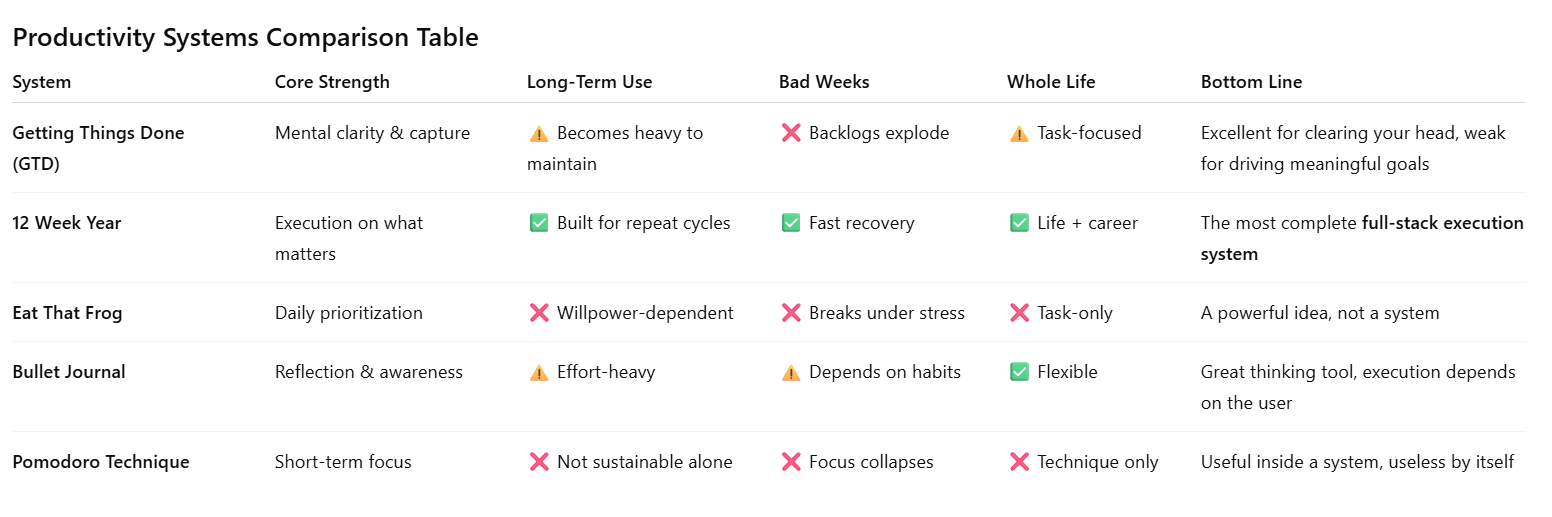
Under high workload, GTD quietly turns into a maintenance system.
Backlogs grow faster than you can process them. During stressful weeks, clarity becomes overhead.
Pattern I’ve seen repeatedly:
GTD works best when complexity is stable. When life accelerates, it collapses into lists.
Verdict:
Powerful for control. Weak for driving meaningful progress.
For a deeper comparison between GTD and the 12-Wee year see my documented experience with the two systems.
And also this interesting comparison.
What it’s good at:
It forces a single, important decision: What matters most today?
Where it breaks:
It relies almost entirely on willpower.
When energy drops, the “frog” stays uneaten — and there’s no recovery mechanism.
How I’ve used it:
As a daily tactic inside larger systems, never as a standalone approach.
Verdict:
A great principle. Not a system.
What it’s good at:
Reflection, awareness, intentional thinking.
For some periods in my life, it helped me slow down and regain clarity.
Where it breaks:
Execution is optional.
Two people can use Bullet Journal in the same way and get wildly different results.
Pattern observed:
It amplifies the user. It doesn’t guide them.
Verdict:
Excellent thinking tool. Execution depends entirely on the person.
For a deeper comparison and understanding of the Bullet Journal systems versus The 12-Week Year see our article comparing the two systems.
What it’s good at:
Lowering resistance to starting. Improving short-term focus.
Where it breaks:
It has no opinion about what you should work on — or why.
During stress, focus alone doesn’t solve priority confusion.
How it should be used:
Inside a real system, never as one.
Verdict:
A technique. Nothing more.
I didn’t adopt the 12 Week Year because it was elegant.
I adopted it because it kept working when everything else broke.
Why it’s different:
It links vision → goals → weekly execution → daily actions
It shortens the execution horizon, creating urgency without burnout
It has built-in recovery through weekly and 12-week reviews
When weeks went sideways, I didn’t “start over.”
I recalibrated — and kept moving.
What I’ve seen across high performers:
This is the only system that repeatedly survives time, stress, and life complexity.
Verdict:
The most robust full-stack productivity system I’ve encountered.
If you would like to get a deeper understanding of The 12-Week year, see our extensive guide on the system.
Get the 12-Week Year template used by our team
A full-stack system handles:
Meaningful goals
Translation into weekly commitments
Daily execution
Recovery from failure
Continuous feedback
Most systems address one layer.
That’s why they feel helpful — until they don’t.
Stop looking for the perfect system.
Instead:
Choose one core system for execution
Use techniques and tools as support
Evaluate systems by outcomes, not feelings
Get the 12-Week Year template used by our team
There is no “best” system in theory. The best system in practice is the one that helps you consistently achieve your most important goals over time, even during stress and low motivation.
Because they are designed for ideal conditions—high motivation, low stress, clear focus. Real life includes bad weeks, overload, and fatigue, and most systems don’t account for that.
A full-stack productivity system covers the entire execution loop:
Vision and goals
Planning and prioritization
Daily execution
Recovery from setbacks
Review and course correction
Most tools handle only one layer.
Yes.
The 12 Week Year is a full-stack productivity system because it integrates vision, goal-setting, weekly planning, daily execution, scorekeeping, and regular review into one repeatable cycle designed to work under real-life conditions.
Because it shortens the execution horizon.
Twelve weeks create urgency, clarity, and focus—while still being long enough to produce meaningful results.
GTD is very effective for mental clarity and task capture, but it lacks a strong mechanism for driving progress on long-term, meaningful goals.
Yes. Many people use GTD inside a broader execution system—but GTD alone is rarely sufficient for goal achievement.
No.
Pomodoro is a focus technique, not a productivity system. It helps you work—but doesn’t tell you what to work on or why.
Bullet Journal is best understood as a reflection and thinking framework. Results depend heavily on the individual using it, not on the system itself.
Because they rely on willpower instead of structure. When energy drops, systems without built-in recovery mechanisms collapse.
You need one core system and multiple tools that support it. Problems arise when tools replace systems.
Only if simplicity doesn’t sacrifice robustness.
Simple systems that fail under stress are not better—they’re incomplete.
Years.
If a system only works for a few months, it’s not a system—it’s a phase.
Only some can. A true system should support work, health, personal goals, and relationships, not just tasks at the office.
Choosing based on aesthetics, popularity, or short-term motivation instead of long-term results.
Evaluate whether it:
Works long-term
Survives bad weeks
Applies across your whole life
If it fails any of these, it’s not enough on its own.