The complete reference guide to the 12-Week Year system and its core components.
Written by: Dan Mintz
Get the 12-Week Year template used by our team
Updated: Jan. 3rd, 2025
TL;DR
The 12 Week Year is a high-performance system, not a productivity or time-optimization method.
Its purpose is to help you achieve the right goals, not just execute tasks efficiently.
The system starts with clear intention and vision, which removes overwhelm before execution begins.
Short 12-week cycles create urgency, focus, and faster learning, without burnout.
Execution only works when it’s designed into a system, not forced by motivation.
Scorekeeping and feedback loops shift focus to behaviors (lead measures), not outcomes alone.
High performance emerges from alignment between vision, goals, planning, and weekly execution—not hacks.
Written by Dan Mintz, productivity strategist and founder of the 12-Week Breakthrough program. Wharton MBA and MIT-trained data scientist, with experience helping doznes of professionals 10x their performance.
The 12-Week Year is a performance system designed to help individuals and teams execute consistently on what matters most.
Its core idea is simple but powerful:
treat 12 weeks as a full year.
The logic behind this time compression—and why it leads to better execution—is explained in detail in why 12 weeks beat a year, and also deeply in this article: Why Is a Year just 12-Weeks in The 12-Week Year?
By shortening the planning horizon, the system:
creates urgency
increases focus
forces prioritization
exposes execution gaps quickly
But the 12-Week Year is not just about shorter cycles.
It works because it integrates vision, goals, planning, execution, and scorekeeping into one unified system.
This integration is what most productivity approaches lack.
For deepr exploration of the main principles of the 12-week year go this article.
Also visit How to Best Manage your Time in the 12 Week Year if you want to learn how top 5% manage their time.
Traditional annual planning fails for predictable reasons:
Goals feel distant → urgency disappears
Too many priorities compete for attention
Progress is reviewed too late to course-correct
Motivation becomes the strategy
The 12-Week Year fixes this structurally.
By compressing time:
consequences become immediate
weekly actions matter again
execution becomes visible, not theoretical
The result is not “working harder,” but working deliberately.
If you really want to double your performance using 12 Week year, you can see How to Double Your Performance Using The 12-Week Year.
Get the 12-Week Year template used by our team
At its heart, the 12 Week Year is a complete and integrated approach to productivity. It is not a hack, or a quick fix. Rather, it is designed to change the way you plan, execute, and measure success. There is strong scientific evidence that using complete productivity systems with several key components is better than using a piecemeal approach.
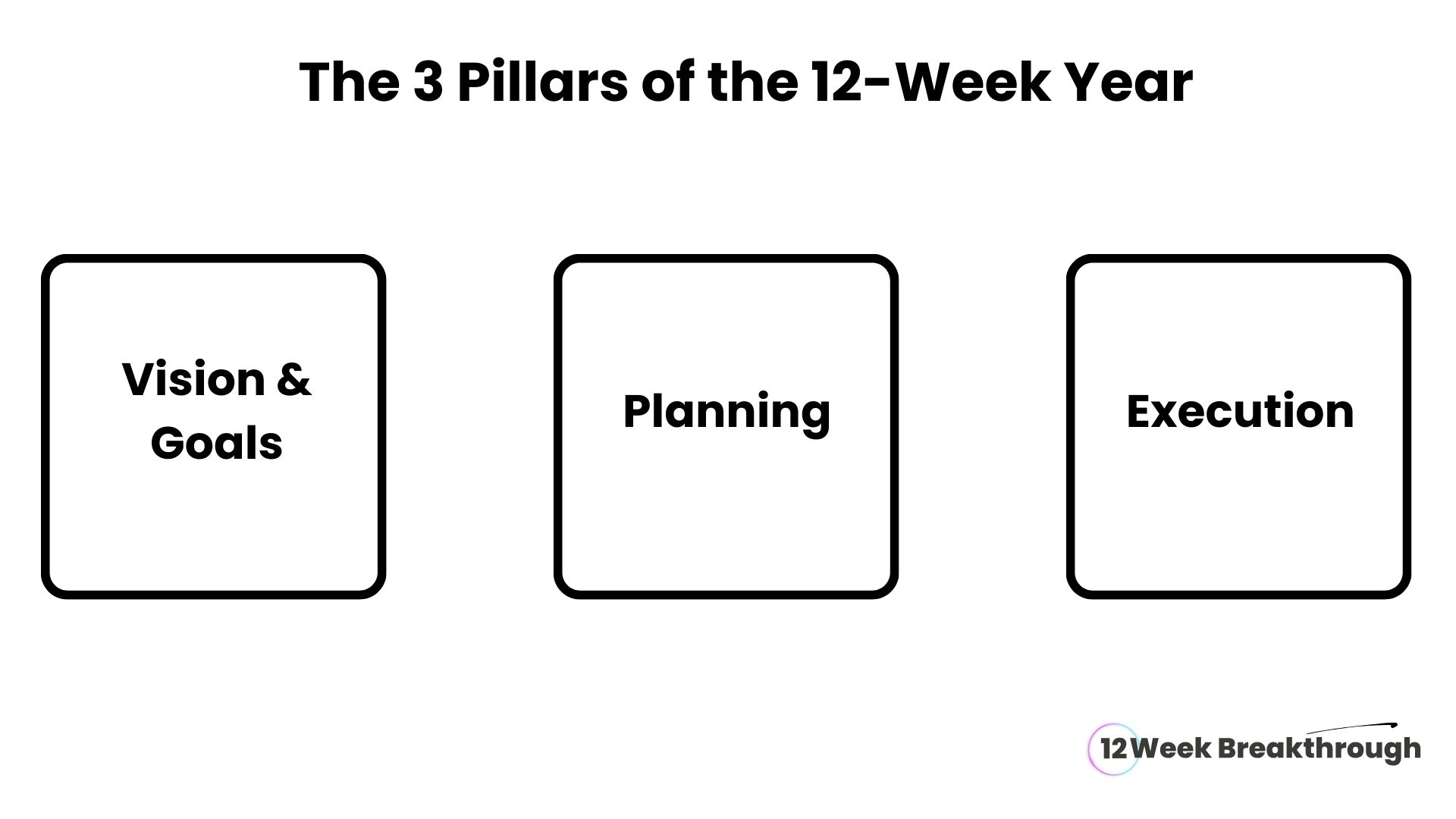
The three pillars of the system are:
1. Vision & Goals
2. Planning
3. Execution
The system is driven by and based on the following fundamental principles:
After the above high level overview of the system, let’s dive into the pillars.
The system works because its components reinforce each other. Remove one, and execution weakens.
Vision defines who you are becoming, not just what you want to achieve.
In the 12-Week Year:
vision is long-term (3+ years)
identity-based
emotionally meaningful
It acts as a filter.
If an action doesn’t serve the vision, it doesn’t belong in the plan.
Each 12-week cycle contains a small number of clear outcomes.
Best practice:
1–3 goals per life or work area
specific and measurable
achievable within 12 weeks
These are not vague intentions.
They are commitments with consequences.
Weekly planning is the engine of the system.
Each week, you:
translate goals into specific actions
schedule them deliberately
remove non-essential work
A useful mental model:
Plan forward. Execute backward.
You plan from the goal — but your week is built from executable actions.
(if you are interested in a specific weekly prioritization system, please check our article about how to prioritize your week. )
Execution in the 12-Week Year is not reactive.
Actions are pre-decided
Time is blocked in advance
The calendar reflects priorities, not intentions
This removes daily decision fatigue and reduces procrastination.
This is where many systems fail — and where the 12-Week Year stands out.
Execution is tracked weekly using a simple execution score:
Execution Score = completed planned actions ÷ planned actions
Target range: 85%
Below 85% = execution problem
Above 85% = system working
The score measures behavior, not results.
Results follow behavior.
Visit How to get more done in 3 hours using the 12-Week Year if you want to replace your reactive to-do lists with a high-leverage priority stack of Deep Work Cycles.
In this pillar we are going to set our direction. What is our vision? What are we trying to accomplish with life? Focus on big ambitions. We are going for major transformations with the 12 week year.
For a deeper explanation of how vision functions within the 12-Week Year system, see how vision drives execution in the 12-Week Year.
Research in goal-setting indicates that goals linked to a meaningful vision are more likely to be accomplished. The vision provides the why and the goals provide the what. Without a vision, goals are not as compelling.
Take for instance the excellent paper by Edward L. Deci and Richard M. Ryan, “The “What” and “Why” of Goal Pursuits: Human Needs and the Self-Determination of Behavior” that clearly states that goals are far more compelling when they are connected to intrinsic needs and meaning. In other words, vision (the why) drives motivation, while goals (the what) provide direction.
Instead of vague dreams, the 12 Week Year asks you to create a concrete, tangible 3-year vision. Identify 2–3 areas of your life that mean the most to you (career, health, relationships, etc.). Write a vivid description of what life looks like in each of those areas three years from now.
Tip: Picture yourself stepping into the future as if it were a 3D world — what do you see? what do you feel? what do you hear?
An excellent source of learning about a vivid vision is the book, “Vivid Vision: A Remarkable Tool For Aligning Your Business Around a Shared Vision of the Future”.
Creating Goals from Your Vision
After the vision is set, define goals using a backward approach:
3-Year Vision → 1-Year Goals → 12-Week Goals.
Consider how important it is to break down/translate your vision into meaningful and clear goals that you can achieve and that will move you closer to your vision. Try to visualize this process in your mind and obtain a deeper understanding of this key concept.
All well-defined goals possess three main characteristics:
The study “The Impact of Commitment, Accountability, and Written Goals on Goal Achievement” (2007) by Prof. Gail Matthews, found that people who wrote down their goals, shared them with a friend, and sent weekly updates were 76% more likely to achieve their goals.
Goals act as the bridge between your long-term vision and the execution plan that brings it to life. This process transforms a big vision into specific, short-term goals you can actually execute on, week by week.
Once your goals are set, the next step is to design the plan that brings them to life, which leads us to the next pillar: Planning.
You can dig deeper about achieveing goals with the 12-week year in our article: The 12 Week Year: Achieve Your Most Ambitious Goals.
In the planning phase we create 2 things:
1. The 12 week execution plan
2. The performance metrics that indicate if you are on track and measure success (or failure)
My client Rachel’s three-year vision was to rank among the top ten architects in her state.
To make this vision a reality, together with Rachel, we defined the 1-year goals that would get her closer to this vision:
And to bring these goals even closer to the present, we translated the 1-year goals into 12-week goals that can be executed in the current cycle:
As you can see, her 12-week goals were clear, measurable, and directly linked to her bigger vision.
Now that we have our 12 week goals clearly defined, we need to create the tasks that will make these goals a reality.
Let’s take Rachel’s first 12-week goal: create 100 new LinkedIn strategic connections.
Rachel defined the critical weekly and daily tasks that she must take to reach this goal at the end of the 12 week year:
Each task is mapped into the 12-week cycle, as you can see here.
And you repeat this process for every 12-week goal.
Now — how do we know if we’re on track?
This is where scorekeeping comes in.
If it isn’t measured, it won’t get done.
Take Rachel’s task: engage with influencer posts three times a week.
We measure three things, weekly:
Execution — did she actually do it three times this week?
Lead indicator — number of comments she posted.
Lag indicator — number of new interactions gained from those comments such as replies, likes and new
For the goal of networking with people on LinkedIn, Rachel established weekly tasks:
She measured:
You can read in more detail Rachel’s case study in Rachel’s Breakthrough Journey: From Overwhelmed Architect to Industry Leader with the 12 Week Year System.
Research supports this. A 2015 meta-analysis showed that when monitoring progress people are more success oriented in their goal pursuit — particularly when progress is recorded or shared.
Harkin, B., Webb, T. L., Chang, B. P. I., Prestwich, A., Conner, M., Kellar, I., Benn, Y., & Sheeran, P. (2015), Does Monitoring Goal Progress Promote Goal Attainment? A Meta-Analysis of the Experimental Evidence. Psychological Bulletin, 142(2), 198–229.
This powerful meta-analysis of 138 studies with nearly 20,000 participants shows that regularly monitoring progress (especially writing it down or sharing publicly) significantly improves goal achievement.
To make is clear:
A lead indicator measures what you can directly control — like the number of comments you write.
A lag indicator measures the outcome you can’t control, but want to track — like how many likes, replies, or new connections you get from those comments.
We now have the 3-year vision, the 1-year goals, and a 12-week plan with goals and performance metrics.
Now it’s time to execute.
Execution is where transformation happens. The 12 Week Year shifts your mindset from planning your activities to doing the work.
This cycle of execution + review creates a built-in feedback loop. Each week, you take stock of what’s working, and at 12-week intervals, you strategically reset and improve.
The 12 Week Year works because it aligns with how humans actually motivate themselves and perform:
To put it simply: the 12 Week Year compresses time, clarifies priorities, and compels consistent execution.
Matthews, G. (2007). The Impact of Commitment, Accountability, and Written Goals on Goal Achievement.
Read here (Dominican University of California)
Harkin, B., Webb, T. L., Chang, B. P. I., Prestwich, A., Conner, M., Kellar, I., Benn, Y., & Sheeran, P. (2015). Does Monitoring Goal Progress Promote Goal Attainment? A Meta-Analysis of the Experimental Evidence. Psychological Bulletin, 142(2), 198–229.
Read here (APA / DOI)
Deci, E. L., & Ryan, R. M. (2000). The “What” and “Why” of Goal Pursuits: Human Needs and the Self-Determination of Behavior. Psychological Inquiry, 11(4), 227–268.
Read here (Self-Determination Theory site)
Locke, E. A., & Latham, G. P. (2002). Building a Practically Useful Theory of Goal Setting and Task Motivation: A 35-Year Odyssey. American Psychologist, 57(9), 705–717.
Read here (ResearchGate)
Each week follows the same loop:
Plan the week (15–30 minutes)
Execute planned actions
Track completion
Review score at week’s end
Adjust next week accordingly
This rhythm creates fast feedback, which is why improvement compounds.
To go deeper about how to implement the 12 week year see The Complete 12-Week Year Implementation Guide for 2026.
Most failures come from breaking the system, not from the system itself.
Common mistakes:
Setting too many goals
Confusing effort with execution
Tracking outcomes instead of actions
Ignoring weekly reviews
Treating the system as motivation-based
The system works when followed mechanically, not emotionally.
If you want to learn more about upgrading your skills using the 12 Week Year, visit Use The 12 Week Year to Identify Your Bottlenecks and Upgrade Your Skills.
If you strip it down completely:
Decide who you’re becoming (vision)
Choose a few outcomes for the next 12 weeks
Define weekly actions that drive them
Schedule those actions
Track execution weekly
Adjust, repeat
That’s it.
Everything else exists to protect execution.
Most productivity advice focuses on:
tools
tricks
motivation
The 12-Week Year focuses on:
structure
feedback
accountability
It doesn’t rely on discipline spikes or inspiration.
It creates conditions where execution is the default.
The system works best for:
professionals overwhelmed by competing priorities
people who plan well but execute poorly
high-performers stuck in maintenance mode
anyone tired of resetting goals every year
It is not for people looking for shortcuts.
If you are looking for a detailed comparison to other perosnal productivity systems see our productivity systems comparion guide.
The power of the 12-Week Year is not the 12 weeks.
It’s the fact that:
vision drives goals
goals drive plans
plans drive execution
execution is measured
feedback is immediate
When all parts work together, progress stops being optional.
If you want to apply the system described above, use the 12-Week Year template used in this guide to implement it exactly as intended.
Yes. Research on goal setting, progress monitoring, and short time horizons supports its effectiveness. Over 80% of people who use the system report multiplying their results within two cycles. The urgency of a 12-week year keeps focus high and procrastination low.
To learn more, please refer to this case study.
Start by creating a vivid 3-year vision, then reverse-engineer it into 1-year goals and 12-week goals. Write down a weekly execution plan, commit to daily MITs (Most Important Tasks), and review your progress every week. At the end of 12 weeks, reset and start your next cycle. Check out our implementation guide here.
Absolutely. The system works whether you’re trying to grow a business, improve your health, deepen relationships, or achieve creative milestones. The framework is flexible — the key is clarity, focus, and execution.
You can further read this comparison of personal productivity systems that talks about this issue.
Traditional annual planning spreads focus thin, making it easy to delay action. The 12 Week Year compresses time into 12-week cycles, creating urgency and frequent review points. Instead of waiting a year to evaluate progress, you adjust every quarter.
You can start with something as simple as a notebook or spreadsheet. Many people use digital tools like Notion, TickTick, or Excel to track weekly scorecards and MITs. The tools matter less than the discipline to execute consistently.
Get the 12-Week Year template used in this guide