The professionals I work with did the same – and 5x-ed their performance in the process.
This one is close to my heart: I believe one of the biggest factors in our success is our ability to follow-through on complex, long-term projects.
The “secret”? Focusing on the single most important thing that keeps us engaged in these long, difficult projects.
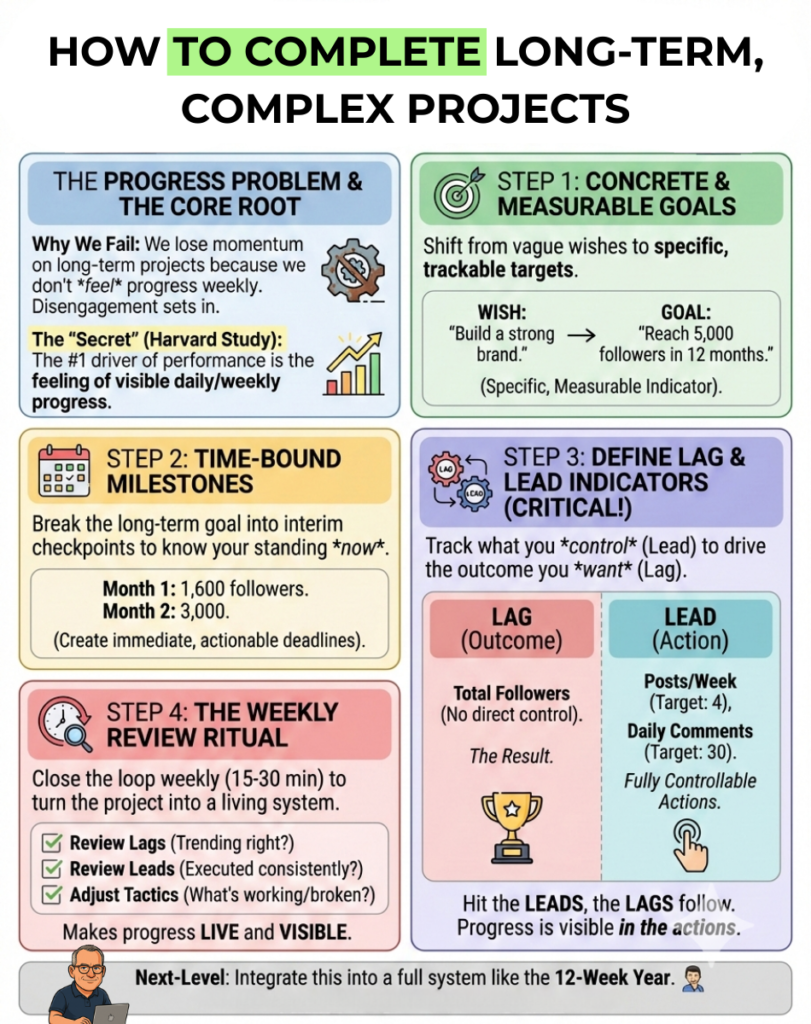
In a groundbreaking study – one of my favorites – Harvard Professor Teresa Amabile tracked 238 knowledge workers across 12,000 workday entries.
Her finding: the single biggest driver of engagement and performance on complex projects is the feeling of visible daily and weekly progress.
Put simply: when we don’t see or feel progress on a weekly basis, we disengage and drift.
So I built a 4-step framework to engineer visible progress.
Here’s how it works using one of my own live projects.
1️⃣ Step 1: Make your goal concrete and measurable.
My goal is to “build a strong personal brand on LinkedIn in 12 months”
Nice. Ambitious. And completely useless as stated.
We cannot cash in wishes.
So I made it real: “Reach 5,000 followers in 12 months.”
Now I have a target I can measure, track, and act on. 5,000 followers is a strong, highly correlated indicator of brand strength – and it tells me exactly what I’m working toward.
2️⃣ Step 2: Break it into time-bound milestones.
A 12-month goal with no checkpoints is just a wish with a deadline.
So I broke it down:
1,600 followers by month 1.
3,000 by month 2.
And so on.
Now I always know exactly where I stand – and whether I’m on track or need to adjust.
3️⃣ Step 3: Define and track lag AND lead indicators.
This is the step most professionals skip entirely – and it’s the most critical one.
A lag indicator is the outcome you’re working toward, but have no direct control over. In my case: number of followers.
A lead indicator is the action that drives the outcome – and it’s fully in your control.
I identified two lead actions with the most direct impact on my outcome:
– Number of posts per week (target: 4)
– Number of daily comments (target: 30)
When your lead indicators are on track, you’re progressing – even before the lag numbers move.
4️⃣ Step 4: Weekly review.
Once a week, for 15 to 30 minutes, I review both sets of numbers.
– Are my lag indicators trending in the right direction?
– Are my lead indicators being executed consistently?
– What’s working? What needs adjusting?
This simple ritual closes the loop:
It turns a long-term complex project into a living system where progress is visible and live.
Next-level performance is achieved when you integrate this process into a complete performance system, such as the 12-Week Year.