An deep dive into a true business owner story of transformation triggered by adopting a system perspective
Created: 27 January, 2026 • by Dan Mintz
Get the 12-Week Year template used by our team

Written by Dan Mintz, a leading productivity strategist, expert in The 12-week year, and the founder of the 12-Week Breakthrough Program. Wharton MBA, MIT Data Scientist, 3x Entrepreneur. Worked with dozens of professionals to transform their lives in 12 weeks, achieve 10x productivity, and overcome inconsistency, overwhelm, and procrastination.
Fifteen years. That’s how long Sam Carpenter fought his telephone answering service business before reaching his breaking point. Working 80-hour weeks, drowning in operational chaos, and staring down a payroll he couldn’t cover, Carpenter found himself lying awake at 3 AM just days before his business would collapse. He had tried everything—better time management, harder work, more determination. Nothing worked.
But that night, something shifted. As Carpenter documents in his transformative book “Work the System,” he experienced what he calls “gun-to-the-head enlightenment.” Instead of seeing his business as an overwhelming mass of problems, he suddenly saw it for what it really was: a collection of independent systems, each operating in a predictable 1-2-3 sequence. His business wasn’t chaotic—it was simply composed of unmanaged systems producing unintended results.

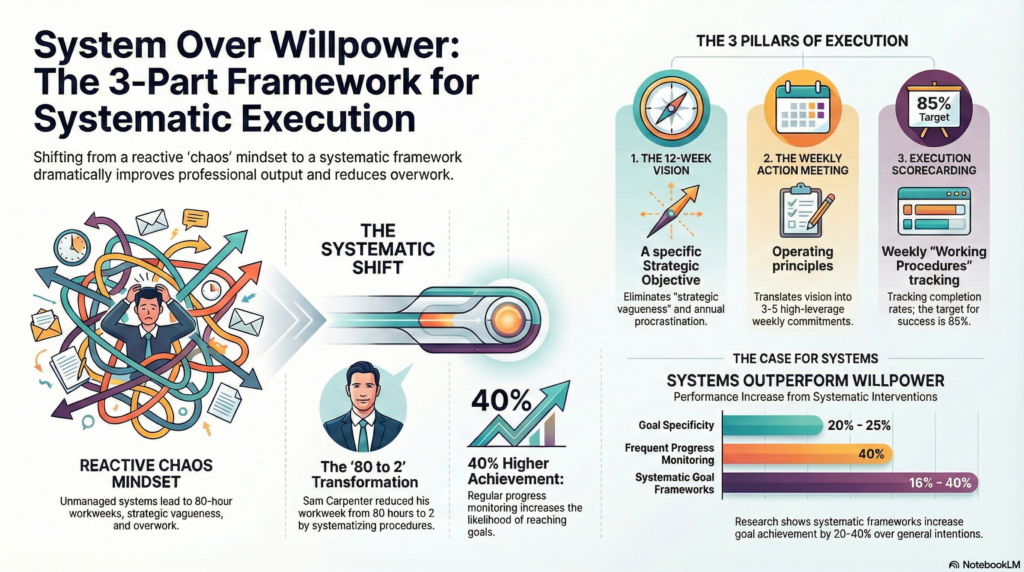
Within days, Carpenter created three documents: a Strategic Objective defining his purpose, General Operating Principles guiding decisions, and Working Procedures documenting execution. The results were immediate. In six months, his workweek dropped from 80 to 60 hours. Six months later, below 40. Within two years, Centratel acquired three local competitors and five nationally, growing from 300 to 700 clients. Today, Carpenter works two hours per week on his business.
This story illustrates a fundamental truth: your inconsistency isn’t a personal failing. It’s a systems problem. The 12-Week Year works because it provides the exact three-part infrastructure Carpenter discovered, purpose-built for individual professionals.
As a strategist who has guided over 50 knowledge workers through 12-Week Year transformations, I’ve witnessed this pattern repeatedly: the difference between chronic inconsistency and reliable execution isn’t willpower. It’s the presence or absence of a complete system.
Get the 12-Week Year template used by our team
When Carpenter rose above his chaos that night, he identified something researchers have validated repeatedly: human performance isn’t primarily limited by motivation or effort. According to goal-setting research by psychologists Edwin Locke and Gary Latham, spanning over 1,000 studies and 40 years, systematic goal frameworks dramatically outperform general intentions, improving performance by an average of 16%. The problem isn’t trying harder—it’s the absence of systematic infrastructure.
Carpenter’s breakthrough centered on three essential documents that researchers in organizational behavior recognize as fundamental to sustained execution:
1. Strategic Objective: Clear Direction
His Strategic Objective answered “What are we actually trying to accomplish?”—providing the clear direction that goal specificity research shows increases achievement rates by 20-25%. Most businesses operate like Carpenter’s did for fifteen years: working hard without a concrete definition of success.
2. Operating Principles: Decision-Making Guardrails
His General Operating Principles created decision-making guardrails, eliminating the decision fatigue that neuroscientist Roy Baumeister’s research has shown depletes willpower and leads to progressively poorer choices throughout the day. Carpenter’s team could now make consistent decisions without his constant involvement.
3. Working Procedures: Systematic Execution
These documents captured the exact sequence of steps for every recurring process. When executed properly, procedures produced the intended result every time. When something went wrong, Carpenter didn’t fight fires—he fixed the procedure. The system improved incrementally, and improvements became permanent through documentation.
In my practice specializing in 12-Week Year implementation for knowledge workers, I’ve witnessed nearly identical transformations across diverse industries. One senior director—let’s call him James—was logging 70-hour weeks managing strategic initiatives. When we implemented his 12-week vision (Strategic Objective), Weekly Action Meeting rhythm (Operating Principles), and execution scorecarding (Working Procedures), his experience mirrored Carpenter’s. Within one quarter, his workweek dropped to 45 hours while strategic output increased.
Watch This Short Video That Summarizes This Article
You are operating a business. Whether you’re a corporate executive, independent consultant, or department head, you manage resources, produce deliverables, serve stakeholders, and compete for results. You are, functionally, a one-person business unit. And like Carpenter’s answering service, you probably lack the systematic infrastructure that prevents chaos.
Consider your typical quarter. You start with ambitious intentions—strategic initiatives, team development, positioning for the next level. Then reality hits. Urgent requests flood in. Meetings multiply. Strategic projects get pushed to next week, then next month, then next quarter. You’re working 50, 60, even 70 hours per week, yet strategic progress remains elusive.
This is exactly where Carpenter was for fifteen years. He wasn’t failing because he lacked talent or determination. He was failing because he was playing Whac-A-Mole with business problems instead of building the systems that would prevent those problems.
A comprehensive meta-analysis of 138 studies involving over 19,000 participants found that monitoring goal progress increases the likelihood of goal achievement by 40%. Yet most professionals operate without any systematic progress monitoring. They set annual goals in January, check progress in December, and wonder why nothing changed.
Through my work implementing the 12-Week Year with over 50 professionals, I’ve seen this pattern in every industry and role level. A marketing executive came to me after three consecutive years of missing strategic objectives despite working evenings and weekends. Her problem wasn’t effort—she was exhausted. She had no Strategic Objective defining success, no Operating Principles guiding prioritization, and no Working Procedures ensuring consistency.
When we installed her 12-Week Year framework, the transformation was immediate. Her 12-week vision gave her the Strategic Objective she’d been missing. Her Weekly Action Meeting became her Operating Principles. Her execution scorecarding became her Working Procedures. Three quarters later, she was promoted and working 15 fewer hours per week.
The 12-Week Year isn’t a time management hack. It’s a complete systematic framework that provides the exact three-part infrastructure Carpenter discovered—strategic clarity, execution principles, and feedback loops—specifically designed for individual professionals.
Carpenter’s Strategic Objective defined what his business was trying to accomplish. The 12-Week Year accomplishes this through your 12-week vision—a concrete, specific picture of what you will achieve in the next 12 weeks.
Research on implementation intentions demonstrates that specific “when-then” plans increase goal achievement rates by 20-30% compared to general goals. Your 12-week vision transforms vague aspirations into concrete outcomes.
Why Quarterly Timeframes Work
The quarterly timeframe is critical. Annual goals fail because they trigger “strategic vagueness”—the comfortable illusion that you have plenty of time. Research on goal proximity shows that deadlines within 12-14 weeks create optimal urgency without overwhelming pressure.
Across my practice, I’ve implemented this principle with dozens of clients who had failed with annual planning for years. One product manager came to me after three years of failing to launch his company’s innovation initiative. When we rebuilt it as a 12-week vision—”Ship MVP to pilot users and collect 50 user feedback sessions by week 12″—he executed it within one quarter.
Carpenter’s General Operating Principles guided decision-making across his business. The 12-Week Year delivers this through the Weekly Action Meeting—a structured rhythm that translates your 12-week vision into specific weekly commitments.
How the WAM Works
Your 12-week vision breaks down into 2-3 goals. Each goal decomposes into weekly actions—specific, high-leverage activities. Every week, you identify the 3-5 most important actions. Not a sprawling task list of 47 items. Three to five specific actions that will move you measurably closer to your vision.
This provides what Carpenter’s Operating Principles provided: a systematic method for prioritizing the vital few over the trivial many.
In my implementation work, I’ve watched this structure transform execution across every professional context. One financial services professional I coached was drowning in 200+ emails daily. When we implemented his WAM rhythm, urgent requests could be evaluated against a clear framework: “Does this support one of my five weekly commitments?” If not, it got delegated, deferred, or declined.
Carpenter’s Working Procedures documented exactly how each process should execute and provided the feedback loop for continuous improvement. The 12-Week Year accomplishes this through execution scorecarding—a systematic method for tracking whether you’re actually doing what you said you’d do.
How Scorecarding Works
Each week, you calculate your execution percentage. If you committed to five weekly actions and completed four, your execution score is 80%. The power isn’t in the calculation—it’s in what the measurement creates. As Carpenter discovered, systems that are measured improve automatically.
The meta-analysis I mentioned earlier found that the frequency of monitoring directly correlates with achievement rates—weekly monitoring significantly outperforms monthly or quarterly check-ins. Weekly scorecarding catches problems in week 3, not month 11.
Real Results From Scorecarding
Having implemented this scorecarding system with dozens of professionals, I’ve seen execution scores transform performance in remarkable ways. One consulting partner had been struggling for two years to build his personal brand. When we implemented weekly scorecarding, the system exposed the truth: he was only executing 30% of his content commitments. Within two quarters, his execution score climbed to 85%, and his LinkedIn following grew from 800 to 4,500.
This isn’t finger-wagging, shame-based accountability. It’s what Carpenter calls “process accountability”—being accountable to the system itself. Did you execute your commitments? The system doesn’t judge your worthiness. It simply reveals whether you did what you said you’d do.
This makes the system self-correcting. When your execution score is 60%, you don’t beat yourself up. You examine what prevented execution—unclear commitments, overly ambitious actions, competing priorities—and you adjust the system.
You don’t need to rebuild your entire life at once. You need to install one system, execute one 12-week cycle, and let the results demonstrate the power of the approach.
Start by asking Carpenter’s fundamental question: What am I actually trying to accomplish? Not over your career—over the next 12 weeks. Choose one area of your professional life that matters most right now.
Write a specific, concrete vision of what success looks like 12 weeks from now. Make it concrete enough that a neutral observer could evaluate whether you achieved it. “Improve leadership skills” is too vague. “Complete leadership coaching program, implement three specific feedback mechanisms with team, and receive positive feedback from at least five team members on improved communication” is concrete.
Choose a specific day and time each week—I recommend Monday mornings—for your 30-minute WAM. This is non-negotiable, like a meeting with your most important client.
In your first WAM, break your 12-week vision into 2-3 goals. Then identify 3-5 weekly actions that will move you toward those goals this week. Schedule these actions as appointments in your calendar. They’re not tasks that might happen—they’re commitments that will happen.
Create a simple spreadsheet or use a notebook to track your execution each week. List your weekly commitments and mark each as complete or incomplete at the end of the week. Calculate your execution percentage.
The target is 85% execution. Not 100%, because perfectionism breeds paralysis. Not 60%, because that’s not sustainable progress. If you’re consistently below 85%, your weekly commitments are too ambitious. If you’re consistently above 90%, you’re not stretching enough.
Within three weeks of implementing this system, you’ll experience what Carpenter experienced: the shift from reactive firefighting to systematic execution.
Q: Sam Carpenter spent 15 years in chaos before his breakthrough. Does that mean the 12-Week Year takes years to work?
No—the opposite is true. Carpenter spent 15 years in chaos precisely because he didn’t have a systematic framework like the 12-Week Year. Once he discovered and implemented his three-part system (Strategic Objective, Operating Principles, Working Procedures), his results were immediate. Within six months his workweek dropped from 80 to 60 hours. The 12-Week Year provides that same three-part system upfront, so you don’t need to spend 15 years figuring it out through trial and error. In my implementation practice, most clients see measurable improvements in their first quarter—the system works immediately because it’s complete from day one.
Q: I already have annual goals at work. Why do I need 12-week goals?
Annual goals create what I call “strategic vagueness”—the comfortable illusion that you have plenty of time, which permits endless procrastination. Research shows that quarterly timeframes create optimal urgency without overwhelming pressure. More importantly, annual goals don’t provide the systematic infrastructure Carpenter discovered. They’re strategic objectives without operating principles or working procedures. The 12-Week Year gives you the complete system, not just the vision.
Q: What if my 12-week vision doesn’t align with my company’s annual goals?
The 12-Week Year isn’t separate from your company goals—it’s the systematic framework for actually achieving them. Take your annual objectives and break them into quarterly milestones. Each 12-week cycle focuses on the next milestone. This approach actually accelerates corporate goal achievement because you’re executing systematically rather than hoping things will somehow come together by December.
Q: The Weekly Action Meeting sounds like just another meeting. Why is it different?
Carpenter’s Operating Principles weren’t “just” guidelines—they were the systematic decision-making framework that made his Strategic Objective achievable. The WAM serves the same function. It’s not about scheduling another meeting. It’s about installing the operating principle that ensures your weeks actually connect to your vision. Without this systematic rhythm, you default to reactive firefighting. With it, you operate proactively from your Strategic Objective.
Q: What’s the difference between “strategic vagueness” and having a long-term vision?
Strategic vagueness is the absence of concrete next steps. Having a five-year vision is valuable—but only if it translates into specific 12-week actions. Carpenter had dreams of growing his business for 15 years. What he lacked was the systematic infrastructure connecting those dreams to daily execution. Long-term vision provides direction. The 12-Week Year provides the execution system that makes that direction actionable.
Q: Sam documented hundreds of Working Procedures for his business. Do I need to do that as an individual?
Carpenter needed hundreds of procedures because he was systematizing an entire business with multiple people and processes. As an individual, your “Working Procedures” are much simpler—they’re your weekly scorecarding system and your WAM rhythm. These two procedures are the systematic infrastructure that makes consistent execution automatic. You’re not documenting every action you take. You’re installing the feedback loops that ensure the vital few actions actually happen.
Q: What execution percentage should I target in my first 12-week cycle?
Don’t aim for perfection. Target 85% execution in your first cycle. This might seem low, but it’s realistic when you’re building new systematic habits. Across my implementation work with over 50 professionals, most clients start closer to 60-70% as they learn to scope their weekly commitments appropriately. The system is self-correcting—if you consistently hit 90%+, you’re not stretching enough. If you’re below 70%, you’re overcommitting. The 85% target balances ambition with sustainability.
Q: Can the 12-Week Year work for personal goals, or is it just for professional objectives?
The systematic framework works for any domain. Carpenter’s breakthrough wasn’t industry-specific—he discovered fundamental principles about how systems operate. Through my implementation work, I’ve guided clients using the 12-Week Year for health transformations, relationship improvements, and creative projects alongside their professional objectives. The three-part system (Strategic Objective, Operating Principles, Working Procedures) is universal. What changes is the content of your 12-week vision, not the systematic infrastructure.
Q: What happens if I miss my 12-week vision? Is the quarter a failure?
Carpenter didn’t transform Centratel in one quarter—he executed systematically over multiple cycles, learning and improving. The 12-Week Year isn’t about perfection. It’s about systematic execution. If you execute 85% of your commitments but fall short of your vision, you’ve still made more strategic progress than most people make in a year. Each cycle teaches you to scope better, commit more effectively, and execute more consistently. The system compounds over time.
Q: How is this different from other productivity methods like Getting Things Done?
Most productivity systems focus on task management—capturing, organizing, and completing individual tasks. The 12-Week Year provides systematic infrastructure at a higher level. It’s not about managing your tasks more efficiently. It’s about ensuring your tasks connect to strategic outcomes through the same three-part system Carpenter discovered: clear vision (Strategic Objective), systematic rhythm (Operating Principles), and feedback loops (Working Procedures). You can use GTD for task management within the 12-Week Year framework.
Q: What if my industry is too unpredictable for 12-week planning?
Carpenter ran a 24/7 answering service—one of the most operationally unpredictable businesses imaginable. Random crises, unexpected client needs, and constant operational fires. The system worked because it didn’t eliminate unpredictability—it created systematic infrastructure that made unpredictability manageable. Your 12-week vision isn’t a rigid plan that breaks under pressure. It’s strategic clarity that helps you evaluate whether today’s urgent request actually matters or is just another mole to ignore.
Q: I’ve tried quarterly planning before and it didn’t work. What makes the 12-Week Year different?
Most quarterly planning is goal-setting without systematic infrastructure. You set goals, create a plan, and hope you’ll execute. The 12-Week Year provides the three-part system that makes execution automatic. It’s not just setting quarterly goals—it’s installing the Strategic Objective (12-week vision), Operating Principles (WAM rhythm), and Working Procedures (scorecarding) that Carpenter discovered. The difference isn’t the timeframe. It’s the completeness of the system.