
Nov. 26th, 2025

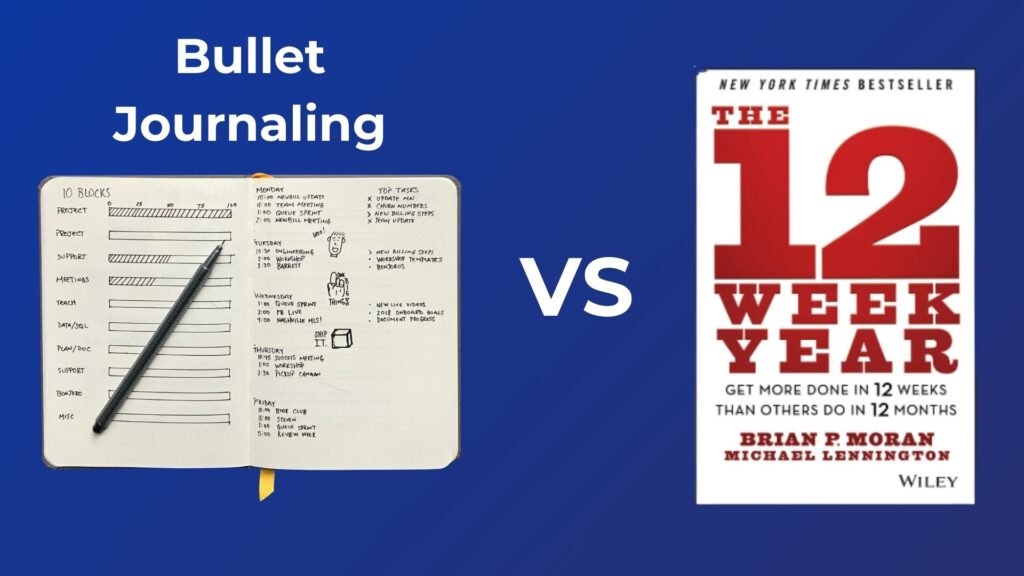
Bullet Journaling is a flexible analog system for organizing tasks, notes, and reflections in one notebook. It excels at mental clarity, self-awareness, and integrating different areas of life, but it doesn’t automatically enforce clear goals, prioritization, or accountability.
The 12-Week Year is a structured execution framework that compresses your goals into 12-week cycles with weekly plans, daily MITs, and scorekeeping. It’s grounded in strong goal-setting and accountability research and is excellent for follow-through and measurable results.
They are not competing tools as much as complementary ones:
Bullet Journal = workspace for your mind & life
12-Week Year = engine for your execution & goals
Use Bullet Journaling if you want flexibility, reflection, and an analog anchor.
Use the 12-Week Year if you want tighter focus, urgency, and consistent progress.
Use both together if you want a calm, human workspace and a powerful system that actually moves your life forward.
Written by Dan Mintz, a leading productivity strategist, expert in the 12 week year, and the founder of the 12-Week Breakthrough Program. Wharton MBA, MIT Data Scientist, 3x Entrepreneur.
Worked with dozens of people to transform their lives in 12 weeks.
Most people who search for “Bullet Journaling vs. The 12-Week Year” are asking a simple question:
“Should I use a flexible analog system like a bullet journal, or a structured execution system like the 12-Week Year to be more productive?”
Surprisingly, there are almost no serious, in-depth comparisons online. That’s a missed opportunity, because these two approaches are built on very different ideas about how humans plan, act, and change.
In this guide I’ll walk you through:
what Bullet Journaling actually is (beyond aesthetics)
what the 12-Week Year really does (beyond “goals in 12 weeks”)
the psychology and research behind both
where each shines and where each fails
who should use which system
and how to combine them into a hybrid that gives you the best of both
I’ve used the 12-Week Year for over 15 years in my own work and with clients, and I’ve also run a multi-month experiment using bullet journaling as my main system. What follows is a neutral, research-backed comparison — written for serious but not necessarily “elite” productivity seekers.
This article is part of our comparison of productivity systems guide.
Bullet Journaling and the 12-Week Year both promise the same thing:
less overwhelm
more clarity
and better follow-through
But they come at the problem from opposite angles:
Bullet Journaling is an open, flexible, analog workspace where you capture, track, and reflect on your life.
The 12-Week Year is a tight, structured execution framework that compresses your goals into 12-week cycles with clear actions and accountability.
Many people sense this difference intuitively. They start a bullet journal to feel more organized, then later look for something like the 12-Week Year when they want stronger results and follow-through.
Let’s go deep into each one.
Bullet Journaling (often “BuJo”) was created by Ryder Carroll, a digital product designer who grew up with ADHD and needed a paper-based way to stay focused and organized.
On the official Bullet Journal site, the method is described as:
“a system that combines elements of mindfulness, productivity, and self-discovery”
helping you “track the past, organize the present, and plan for the future.
Originally, it was a minimalist way to manage tasks, events, and notes. Over time, a global community turned it into a rich ecosystem of techniques, layouts, and styles — from ultra-minimalist to highly artistic.
The “official” Bullet Journal method is built around a few core components:
Index
The first pages of the notebook.
You list page numbers and topics so you can find things later.
Future Log
A high-level overview of the months ahead.
Used for big dates, deadlines, future tasks.
Monthly Log
A simple calendar view plus a task list for the month.
You list events (left) and tasks (right) for that month.
Daily Log
The core of the system.
Each day you rapid-log tasks, events, and notes as bullet points.
Bullets and Signifiers
Different symbols indicate the type and status of an entry, for example:
• task
o event
– note
x task completed
> task migrated (moved forward)
< task scheduled (moved to calendar)
Collections
Thematic pages like “project X,” “books to read,” “fitness log,” “meeting notes.”
They can appear anywhere in the notebook; you simply index them.
Migration
Periodically (typically monthly), you review your entries.
Tasks that still matter are migrated forward; others are intentionally dropped.
This is where Bullet Journaling becomes less about writing and more about deciding.
In practice, a basic bullet journal can be maintained in 5–15 minutes per day, plus some extra time at the end of each month to review and migrate.
Bullet Journaling is particularly good at:
Reducing mental clutter
One notebook becomes the external brain that holds tasks, notes, and ideas instead of your head.
Integrating different parts of life
Work, personal, health, finances, ideas — all in one system.
Improving reflection and self-awareness
Regular writing and reviewing supports emotional processing, meaning-making, and awareness of patterns.
Supporting mental health and stress management
There is a large body of research showing journaling in general can reduce stress, improve mood, and support mental health.
Enhancing focus and memory
Writing by hand activates multiple brain regions and has been linked to better retention and comprehension compared to typing.
Providing a sense of control
Especially in busy or chaotic environments, having an analog anchor can significantly reduce perceived overwhelm.
From a productivity-system standpoint, Bullet Journaling has some clear limitations:
No built-in goal framework
You can track goals, but the method doesn’t define how to set clear, measurable outcomes.
No explicit execution cadence
There’s no standard weekly plan, weekly scorecard, or review rhythm beyond migration.
Relies heavily on self-discipline
If you stop using the notebook for a few days, the system doesn’t “push back.” It quietly decays.
Easy to drift into “maintenance without progress”
It feels organized, but you can spend a lot of time curating layouts, spreads, and trackers without significantly changing your results — something many users have noted in personal accounts and productivity experiments.
In short:
Bullet Journaling gives you a flexible, reflective analog workspace, not a full execution framework.
The 12-Week Year was developed by Brian P. Moran and Michael Lennington, and introduced widely through their 2013 book The 12-Week Year: Get More Done in 12 Weeks than Others Do in 12 Months:
The core principle is simple but powerful:
Stop planning your life in 12-month years.
Treat each 12-week period as a “year” with its own goals, plan, and review.
According to the official 12-Week Year site, the framework is designed to:
compress goals into shorter execution cycles
create urgency and eliminate complacency
increase clarity and control
and translate ideas into disciplined action
The 12-Week Year is built around a clear chain:
Vision
A compelling picture of the future you want — personally and professionally.
This is your “why.”
12-Week Goals
You convert your vision into 1–3 measurable goals for the next 12 weeks.
Example: “Sign 8 new consulting clients” or “Lose 5kg and exercise 3x/week.”
Weekly Plan
Each week, you define the specific actions that directly drive those goals.
These actions are often called “tactics” or “critical actions.”
Daily Execution (MITs)
You pull the most important weekly actions into your day as Most Important Tasks (MITs).
Scorekeeping
You track your execution percentage (e.g., “I completed 82% of planned actions this week”).
This focuses on lead measures — actions you control — not just lag results.
Weekly Review & Accountability Meeting
You review what worked, what didn’t, and what to adjust.
In the full model, you also have an accountability group or partner.
13th Week Review
After 12 weeks, you run a more thorough retrospective before starting the next cycle.
In practice, the weekly planning and review can be done in 30–60 minutes per week, plus a few minutes daily to check and execute MITs.
The 12-Week Year aligns closely with several well-established research findings:
Specific, challenging goals improve performance
Decades of research by Locke and Latham show that specific, difficult goals reliably lead to higher performance than vague “do your best” intentions.
Shorter time horizons increase urgency and focus
When deadlines are near, people procrastinate less and prioritize better — a principle the 12-Week Year makes systematic.
Written goals + accountability outperform “internal intentions”
Studies by Gail Matthews and others show that people who write down goals and send weekly progress updates achieve significantly more than those who only think about their goals.
Regular review improves alignment and execution
Weekly check-ins and performance reviews, when done well, help individuals correct course, maintain engagement, and focus on what matters.
In other words, the 12-Week Year is not just a planning trick. It’s a practical application of robust behavioral science.

The 12-Week Year is particularly good at:
Combating annual drift and procrastination
Shorter cycles mean less “I’ll start that later this year.”
Creating clarity
You work on fewer goals, with clear actions.
Improving follow-through
Weekly scorekeeping and accountability make it harder to hide from your own plans.
Making progress measurable
You can see both execution (actions) and outcomes (results).
Scaling across roles or teams
Because the structure is repeatable, organizations can use it across departments.
From a system-design perspective, the 12-Week Year also has limitations:
Less emphasis on capture and reflection
It tells you what to do, but it doesn’t prescribe where you store your notes, ideas, and daily details.
Can feel rigid if misapplied
Some people try to pack too many goals into a cycle, turning the framework into a source of stress.
Emotionally “dry” compared to journaling
It’s a powerful execution engine, but it’s not designed as a space for emotional processing or creativity.
In short:
The 12-Week Year gives you a structured execution framework, not a rich reflective workspace.
Bullet Journaling sits on top of three big ideas:
Journaling improves mental health and clarity
Narrative and expressive writing have been shown to reduce stress, support emotional processing, and build self-awareness.
Handwriting has unique cognitive benefits
Recent neuroscience work suggests handwriting engages more distributed neural circuits than typing, improving memory and long-term learning.
Autonomy matters for motivation
Self-Determination Theory tells us that autonomy (feeling in control), competence, and relatedness are core psychological needs. Bullet journaling is highly autonomy-supportive: you design your own system, at your own pace.
This helps explain why many people describe bullet journaling as both productive and calming.
The 12-Week Year leans into other pillars:
Goal-Setting Theory
Specific, challenging goals + feedback are consistently linked to higher performance.
Weekly review and accountability
People who regularly monitor progress — especially with external accountability — achieve more.
Shorter time frames reduce “time inconsistency”
By compressing goals into 12 weeks, you reduce the gap between intention and action and make it easier to sustain urgency.
Together, Bullet Journaling and the 12-Week Year are grounded in complementary strands of evidence: one around reflection and meaning; the other around focus and execution.
Here’s a compact but in-depth comparison across key dimensions.
Bullet Journal:
Open-ended. You can plan days, months, or years, but there’s no default time frame.
12-Week Year:
Fixed 12-week cycles + weekly planning + daily execution.
Implication:
Bullet Journaling is more fluid; the 12-Week Year is more rhythmic and cyclical.
Bullet Journal:
High flexibility. You design every spread, layout, and collection.
12-Week Year:
High structure. Core elements (goals, weekly plan, scorecard, review) stay consistent.
Implication:
If you love designing your own system, Bullet Journaling will feel natural. If you want a proven structure with fewer decisions, the 12-Week Year will feel relieving.
Bullet Journal:
Capable, but goals are only as clear as you make them. No built-in measurable goal framework.
12-Week Year:
Forces specific, measurable goals and a small number of priorities.
Implication:
For serious goal achievement, the 12-Week Year has a clear edge.
Bullet Journal:
Daily log captures tasks, events, notes. Easy to drift into long lists with little prioritization.
12-Week Year:
Daily MITs derive from a weekly plan linked to clear goals.
Implication:
If you struggle with “too many tasks, not enough progress,” the 12-Week Year’s MIT structure is more helpful.
Bullet Journal:
Excellent for introspection, gratitude logs, mood tracking, habit trackers, and narrative reflection.
12-Week Year:
Focuses on functional reflection: what worked, what didn’t, what to adjust.
Implication:
If you want productivity and emotional processing in one place, the Bullet Journal is superior. The 12-Week Year is more clinical here.
Bullet Journal:
Self-accountability only, unless you intentionally share it with someone.
12-Week Year:
Designed with accountability groups and weekly scorecards in mind.
Implication:
If you know you perform better when someone else sees your commitments, the 12-Week Year is a better fit.
Bullet Journal:
Very low barrier to entry: a notebook and a pen.
12-Week Year:
Requires initial thought: vision, 12-week goals, and tactical planning.
Implication:
Bullet Journaling is easier for beginners. The 12-Week Year pays off more as you lean into it.
like writing by hand
want a single place for everything
care about reflection and self-awareness
have a mix of personal, work, and creative responsibilities
want an adaptable system that grows with you
are at an early stage in your productivity journey and just need structure and calm
have clear things you want to achieve (career, business, health, income)
often start strong but fail to follow through
struggle with procrastination and “I’ll do it later this year” thinking
want objective measurement of your execution
are ready to work in focused cycles with weekly reviews
want the calm, creative side of a journal
want the focus and urgency of a structured system
like analog thinking but need a strong execution engine
want your days to feel grounded and your goals to move forward
This hybrid is what I eventually formalized as my 12-Week Breakthrough: a system that uses the 12-Week Year as the execution core and blends in the reflective, analog, and human elements that journals do so well. But you don’t need a new brand name to get started — you can build the hybrid with the tools you already have.

If you want to use both, here’s a simple starting point.
In a digital document or a dedicated spread in your journal:
Write a short vision for the next 12 weeks.
Set 1–3 measurable goals for the cycle.
For each goal, list 3–7 weekly actions that will drive it.
(That’s your 12-Week Year layer.)
In your bullet journal:
Create a weekly spread with:
top: your 12-week goals (short summary)
middle: this week’s MITs (linked to those goals)
bottom: space for notes / reflections
At the end of the week:
score your execution (e.g., “I completed 7 of 10 planned actions”)
note what helped and what got in the way
In your daily log:
pull 2–4 Most Important Tasks from the weekly plan
log everything else as normal tasks, events, and notes
at the end of the day, migrate or drop tasks intentionally
This way:
your bullet journal holds your life, thoughts, and daily reality
the 12-Week Year layer ensures your actions line up with real, measurable goals
You get flexibility and focus. Reflection and execution.
It depends how you use it.
The official Bullet Journal method can function as a productivity system because it includes capturing, organizing, and regularly reviewing tasks through migration.
But in practice, many people use it primarily as an organizational and reflective tool — not as a full execution framework with measurable goals, prioritization, and accountability.
No.
The original Bullet Journal method is intentionally minimalist: simple bullets, a monthly log, a daily log, and collections.
The elaborate decorative spreads you see on social media are optional. A purely functional bullet journal can be extremely effective.
Not at all.
While it became popular in business and sales environments, the framework is widely used by individuals for fitness, writing, career transitions, personal projects, and habit building.
Its principles — short cycles, clear goals, weekly planning, and measurement — are universal.
Both systems are practitioner-designed, but they rest on strong underlying research:
Journaling and expressive writing → supported by research on mental health, clarity, and emotional resilience
Handwriting vs. typing → handwriting improves memory, comprehension, and cognitive processing
Specific, challenging goals + feedback → consistently linked to higher performance
Written goals + accountability → strongly correlated with higher achievement
In other words: the branded systems are modern containers built on well-established psychological principles.
Yes — you can replicate the core structure (index, logs, collections) in tools like Notion, OneNote, or GoodNotes.
You’ll still get the organizational and reflection benefits.
The only tradeoff: you may lose some of the cognitive advantages associated with handwriting.
If you implement it seriously — meaning clear goals, proper weekly planning, daily MITs, and weekly scorekeeping — most people feel an improvement within 2–3 weeks.
By the end of the first 12-week cycle, you’ll typically see tangible results.
The biggest breakthroughs often appear in the second cycle, once the system becomes part of your routine.
It can replace it as your primary system if you:
define measurable goals
create your own weekly execution structure
maintain regular reviews
hold yourself accountable consistently
Some people do this successfully.
But out of the box, Bullet Journaling is better at organizing and reflecting than at driving consistent execution on a small set of measurable goals.
It can replace it as your execution framework, but it does not replace a journal’s strengths:
daily capture
emotional processing
brainstorming
unstructured notes
reflection
long-form thinking
Many people end up pairing the 12-Week Year with a journal or digital equivalent.
Try this for one 12-week cycle:
Daily:
Use a Bullet Journal for capture — tasks, notes, ideas, reflections.
Weekly:
Create a simple 12-Week Year spread that includes:
1–3 goals
weekly action plans
weekly execution scores
This setup lets you feel the strengths of both systems quickly — and you’ll know whether you prefer analog flexibility, structured execution, or the hybrid.
My 12-Week Breakthrough builds on the 12-Week Year but integrates:
science of vision and meaning
deliberate practice
deep work principles
digital minimalism
journaling and reflective practices
It’s a modern, research-aligned evolution of 12-week execution — designed for today’s knowledge work and the realities of distraction, overwhelm, and split attention.
It often uses Bullet Journals (or their digital equivalents) as the daily workspace.
But even if you never adopt the full 12-Week Breakthrough, understanding how Bullet Journaling and the 12-Week Year differ — and how they can work together — will already put you far ahead of most people who rely on just one system in isolation.
Bullet Journaling — Pros:
Highly flexible and customizable
Great for reflection, creative thinking, and emotional clarity
One place for tasks, notes, ideas, and tracking
Encourages mindfulness and self-awareness
Bullet Journaling — Cons:
No built-in goal-setting framework
No accountability or execution mechanics
Easy to drift or lose structure
Can become time-consuming if over-designed
The 12-Week Year — Pros:
Clear, measurable goals and tight execution cycles
Weekly planning + daily MITs build consistency
Built-in accountability and scorekeeping
Reduces procrastination through shorter horizons
The 12-Week Year — Cons:
Less creative and reflective
Can feel rigid for people who prefer fluid systems
Requires upfront clarity (goals, actions, metrics)
Doesn’t act as a catch-all notebook for daily life
Bottom Line:
Bullet Journaling excels at organizing and reflecting;
The 12-Week Year excels at executing and achieving;
A hybrid often gives you the best of both worlds.

Dan Mintz is the creator of the 12 Week Breakthrough Program. He advised dozens of individuals on how to achieve their most ambitious goals and reach their full potential.
Dan can be reached at:
dan.mintz@12week-breakthrough.com
About Dan Mintz
Additional Links:
Join the Program
Our Blog Page
https://12week-breakthrough.com/12-week-system-vs-productivity-hacks/
12 Week Year Implementation Guide 2026
Getting Things Done vs the 12 Week Year
Ahcieve Your Most Ambitious Goals with the 12-Week Year
Why 12 Weeks vs 12 Months?