Stop guessing and start scoring. The 12-Week Year replaces reactive to-do lists with a high-leverage priority stack of Deep Work Cycles to drive your 12-week goals.
Created: March 29th, 2026 • by Dan Mintz
Get the 12-Week Year template used by our team
Written by Dan Mintz, a leading productivity strategist, expert in The 12-week year, and the founder of the 12-Week Breakthrough Program. Wharton MBA, MIT Data Scientist, 3x Entrepreneur. Worked with dozens of professionals to transform their lives in 12 weeks, achieve 10x productivity, and overcome inconsistency, overwhelm, and procrastination.
I used to believe that serious deep work meant long, unbroken blocks of grinding focus. Six hours, calendar blocked, noise-cancelling headphones on, world shut out. That’s what elite performance looked like, right?
By hour three, I was re-reading the same sentence four times. By hour five, I was producing garbage dressed up as effort. The calendar said “deep work.” My output said otherwise.
Something was fundamentally broken. I was treating deep work as a time problem when it was actually an energy management problem. And that single reframe changed everything about how I structure execution inside my 12 Week Year cycles.
The answer is neurological. Sustained cognitive effort depletes the brain’s prefrontal cortex resources. Research from cognitive psychology consistently shows that the quality of focused knowledge work declines sharply after about 60 to 90 minutes of sustained effort. After that threshold, you’re not doing deep work anymore. You’re doing an expensive imitation of it.
Cal Newport, in his foundational book Deep Work: Rules for Focused Success in a Distracted World, makes the case that deep work is cognitively demanding precisely because it pushes you to your limit. The implication most people miss: limits exist, and ignoring them costs you output. Newport’s own research subjects — including doctoral students and professional writers — rarely exceeded four hours of genuinely deep work per day (see Newport’s deep work research).
This is why the person doing three focused hours often outperforms the person doing six unfocused ones. It’s not about discipline. It’s about working with your cognitive architecture, not against it.
If you want to master the 12 Week Year System, visit The 12-Week Year: The Ultimate Guide.
The Deep Work Cycle is a structured protocol that treats your cognitive energy as the primary constraint on output quality. Instead of optimizing for time-in-seat, you optimize for output-per-session by cycling between high-energy work and full recovery.
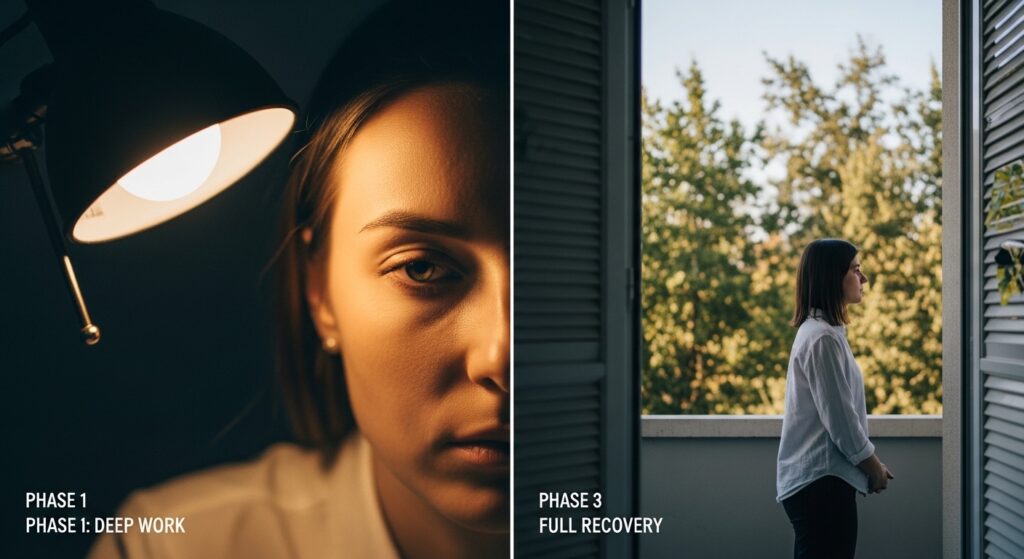
The cycle has three phases:
Single-task execution on your most important work. This is not multitasking. It’s not checking Slack between paragraphs. It’s pushing to real cognitive strain on one MIT (Most Important Task) that directly advances a 12-week goal. You work until you feel genuine mental resistance — the point where clarity starts to drop.
When your focus quality degrades, you stop. Not in an hour. Not at the end of a Pomodoro timer. When your brain signals decline, you stop. Most professionals lose their best output right here because they push through the decline, mistaking fatigue for grit. The research on decision fatigue and ego depletion from the American Psychological Association explains why: willpower and cognitive focus draw from the same limited pool of mental resources.
This is the phase that most people sabotage. Full recovery means no screens, no inputs that trigger cognitive engagement. No email, no Slack, no scrolling. Instead: walk, stretch, stare out a window, do yoga, paint — anything that fully disengages your executive function. Research on attention restoration theory (Kaplan, 1995) shows that exposure to restorative environments replenishes directed attention capacity. This is the mechanism that makes the next session actually productive.
Then repeat. Two cycles per day maximum. That’s your ceiling, not your floor. Do this well and you are producing more high-quality output than the vast majority of knowledge workers who grind through unfocused six-hour blocks.

Here’s where the Deep Work Cycle goes from a nice productivity technique to a real execution weapon. On its own, cycling between focus and recovery is effective. But without a system around it, it degrades. You skip days. You don’t know what to work on. You lose track of whether it’s actually moving the needle.
The 12 Week Year, developed by Brian Moran, provides that system. And the 12 Week Breakthrough (my enhanced execution operating system built on Moran’s framework) maps the Deep Work Cycle directly to each of its five core pillars.
Without a clear vision, deep work becomes a productivity exercise disconnected from purpose. The 12 Week Breakthrough starts with a 3-year identity-based vision: Who are you becoming? What does your life look like when you’re operating at the top 5% of your field? Vision creates the emotional fuel that makes you show up for cognitively demanding work on Tuesday morning when motivation is low. When you sit down for a Deep Work Cycle, you’re not just “focusing.” You’re executing on actions that connect to a future identity you’ve deliberately chosen.
The 12 Week Breakthrough uses a multi-horizon goal architecture: 3-year vision cascades to 1-year outcomes, which cascade to 12-week execution goals. Each 12-week goal has defined lead actions — the specific, measurable behaviors that drive results. When you sit down for a 60–90 minute deep work session, you’re not choosing from a vague to-do list. You’re executing a specific MIT that maps to a specific 12-week goal. That precision is what separates productive deep work from busy deep work.
This is where the Deep Work Cycle lives inside the 12 Week Breakthrough system. The Execution Engine converts goals into repeated weekly behaviors. MITs (Most Important Tasks) are the minimum effective weekly actions that directly drive your 12-week goals. The Deep Work Cycle is how you execute those MITs at the highest possible quality.
A critical rule from the system: a task not placed into calendar time is not an execution plan; it is a wish. Your deep work cycles must be scheduled as specific time blocks in your calendar. Not “I’ll do deep work sometime this morning.” But “9:00–10:30 AM: Deep Work Cycle 1 — draft investor pitch deck (MIT #2, tied to Q1 fundraising goal).”
This is Calendar as Control System — one of the non-negotiable constraints of the 12 Week Breakthrough. If it’s not on the calendar, it’s not happening.
The 12 Week Breakthrough runs on a weekly cadence with two essential rituals: the Weekly Planning Session (WPS) and the Weekly Review (WRev).
In your WPS, you decide exactly which MITs will get deep work blocks this week, schedule them into your calendar, and identify risks or constraints that could derail execution. This is where you map two deep work cycles per day to specific deliverables that advance your 12-week goals.
In your WRev, you look back at what happened. Did you complete your planned deep work cycles? Were you disciplined about stopping at decline? Did you actually recover, or did you check email during your recovery window? The weekly review turns subjective feelings (“I think I had a productive week”) into objective data.
The Scorecard is the 12 Week Breakthrough’s core feedback mechanism. It tracks lead actions (what you did) and lag results (what happened as a consequence). For deep work, your lead indicators might include: number of completed deep work cycles per week, percentage of MITs executed during deep work blocks, and adherence to the stop-at-decline protocol.
Your lag indicators track the downstream results: client deliverables completed, chapters written, features shipped, revenue generated.
The system targets an 85% execution threshold. If you planned ten deep work cycles this week and completed eight or more, you’re on track. Below 85% consistently, something is broken in your system — and the scorecard tells you exactly where.
This is what separates the 12 Week Year approach from generic deep work advice. Generic advice says “do deep work.” The 12 Week Breakthrough says “measure it, review it weekly, course-correct, and keep executing against a specific goal with a 12-week deadline.” The research on progress monitoring and goal attainment confirms this: people who record and review their progress are significantly more likely to achieve their goals.

Get the 12-Week Year template used by our team
Because it solves both failure modes simultaneously.
Failure Mode 1: High effort, low output. The person who grinds six hours of “deep work” but produces diminishing-quality output after the first 90 minutes. The Deep Work Cycle eliminates this by making energy, not time, the governing constraint.
Failure Mode 2: Good technique, no system. The person who knows about deep work but applies it inconsistently because there’s no goal architecture, no weekly plan, no scorecard, and no accountability loop. The 12 Week Year framework eliminates this by wrapping the technique inside a closed-loop execution operating system.
When you combine structured energy cycling with the 12 Week Breakthrough’s five pillars — vision, goal architecture, execution engine, weekly operating rhythm, and measurement — you get something that’s genuinely rare: sustainable, high-quality output that compounds over 12-week cycles.
If you want to implement this immediately, here’s the minimum viable version:
That’s the system. Two high-quality cycles per day, tracked weekly, integrated with a 12-week goal. Do this consistently and you’re already operating at a level most professionals never reach — not because they lack talent, but because they lack a system that makes peak output repeatable.
Deep work is not about how many hours you can sit in a chair. It’s about how much high-quality cognitive output you can produce per session and how many sessions you can sustain per week without burning out.
The Deep Work Cycle gives you the session structure. The 12 Week Year gives you the execution system. Together, they turn deep work from an occasional productivity win into a repeatable engine that drives measurable results every single week of your 12-week cycle.
Three focused hours. Two cycles. One system. That’s how you outperform the six-hour grinders.
The Deep Work Cycle is a structured energy management protocol for knowledge work. It consists of three phases: 60–90 minutes of single-task deep work pushed to real cognitive strain, stopping when mental clarity declines, and 10–20 minutes of full recovery with no screens or cognitive inputs. You repeat this cycle twice per day maximum to sustain high-quality output without burnout.
The Pomodoro Technique uses fixed 25-minute intervals with short breaks. The Deep Work Cycle is governed by energy, not arbitrary timers. You work for 60–90 minutes and stop when cognitive quality declines, not when a timer rings. The recovery phase is also different: Pomodoro breaks are brief, while the Deep Work Cycle requires full cognitive disengagement — no screens, no inputs — to genuinely restore attention capacity.
Research consistently shows that most professionals can sustain about three to four hours of genuinely deep cognitive work per day. Two 60–90 minute cycles with recovery fall right in that range. Going beyond this threshold produces sharply diminishing returns and accelerates burnout, which destroys consistency across a 12-week execution cycle.
The 12 Week Year (developed by Brian Moran) provides the execution system that makes deep work sustainable and goal-directed. The Deep Work Cycle maps directly to the 12 Week Breakthrough’s five pillars: vision provides meaning, goal architecture tells you what to work on, the execution engine schedules deep work as MITs in your calendar, the weekly operating rhythm plans and reviews your cycles, and measurement tracks execution via a Scorecard against the 85% threshold.
The recovery phase requires full cognitive disengagement. That means no email, no Slack, no social media, no reading articles — nothing that triggers executive function. Effective recovery activities include walking outside, stretching, yoga, light physical movement, staring out a window, or any low-stimulation activity. This is grounded in attention restoration theory, which shows that restorative environments replenish the directed attention capacity your brain just depleted.
MIT stands for Most Important Task. In the 12 Week Breakthrough, MITs are the minimum effective weekly actions that directly drive your 12-week goals. They are not urgent tasks or busywork. They are the system’s chosen lead actions — the controllable behaviors that predict results. Each deep work session should be dedicated to executing one MIT.
Use the 12 Week Breakthrough Scorecard to track lead indicators (number of completed deep work cycles, percentage of MITs executed during deep work blocks, adherence to the stop-at-decline protocol) and lag indicators (deliverables completed, measurable progress toward 12-week goals). The system targets an 85% execution threshold: if you planned ten deep work cycles and completed eight or more, you are on track.
The 85% execution threshold is the performance benchmark in the 12 Week Year system. It means completing 85% or more of your planned lead actions each week. This threshold accounts for real-life variability while maintaining the execution consistency needed to hit 12-week goals. Consistently scoring below 85% signals a systemic breakdown that needs to be addressed in your Weekly Review.
Occasionally, yes, but the system recommends two as the sustainable maximum. The goal is not to maximize any single day — it is to maximize output across an entire 12-week cycle. Adding a third session might boost one day’s output but often leads to fatigue that reduces output in subsequent days. Consistency beats intensity. The 12 Week Breakthrough is designed for sustained execution, not heroic sprints.
The Weekly Planning Session (WPS) is a recurring ritual in the 12 Week Breakthrough where you plan your upcoming week’s execution. For deep work, this means deciding which MITs will receive deep work blocks, scheduling those blocks as specific time entries in your calendar, and identifying any constraints or risks. The WPS ensures that deep work does not happen by accident or aspiration — it happens because it is planned and scheduled with the same rigor as any other critical commitment.