A deep dive into the logic of why operating in a 12-week year is superior to operating in 12-months cycles.
Created: 04th Feb., 2026 • by Dan Mintz
Get the 12-Week Year template used by our team

Written by Dan Mintz, a leading productivity strategist, expert in The 12-week year, and the founder of the 12-Week Breakthrough Program. Wharton MBA, MIT Data Scientist, 3x Entrepreneur. Worked with dozens of professionals to transform their lives in 12 weeks, achieve 10x productivity, and overcome inconsistency, overwhelm, and procrastination.
Most professionals plan their year in January and realize by March they’re already behind.
By June, goals feel distant. By September, urgency finally kicks in—but it’s too late. The pattern repeats every year, not because people lack discipline, but because the 12-month structure itself makes failure likely.
In this post, I’ll show you why operating in 12-week execution cycles creates structural advantages that annual planning can’t match.
You’ll see the research proving why short cycles work, the exact execution failures that long horizons create, and real examples of how this shift transforms results.
This article is part of our series about what is a 12-week year.
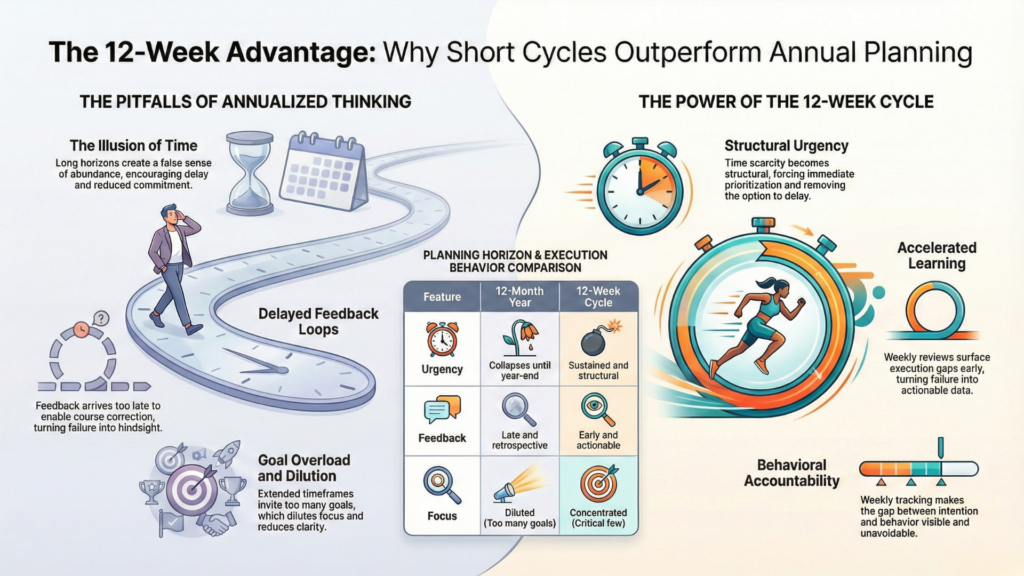
When you set a goal in January with a December deadline, your brain registers “plenty of time.” This isn’t laziness—it’s temporal discounting, a well-documented cognitive bias where humans systematically undervalue future consequences.
Research published in Psychological Science demonstrates that distant deadlines reduce perceived urgency, even when the task’s importance remains constant1. The further away a deadline sits, the less pressure you feel to act today.
What this looks like in practice:
A 12-month cycle provides feedback only at year-end—when it’s too late to make meaningful adjustments. Control systems theory tells us that systems cannot self-correct without timely feedback loops.
Consider steering a ship: if you only check your compass once per year, you’ll drift miles off course before realizing it. Annual reviews function the same way—they reveal problems long after they compound.
Long time horizons invite goal proliferation. When you have “a whole year,” it’s tempting to pursue multiple objectives simultaneously. Research on goal-setting shows that the more goals people pursue concurrently, the lower their completion rate.
This isn’t about capability—it’s about cognitive load. In a 12-month framework:

A 12-week window removes the luxury of delay. When your entire “year” is 12 weeks, every week carries weight. There’s no “later in the year”—you’re always in the critical phase.
The 12 Week Year system treats each 12-week period as a complete year, creating what Brian Moran calls “execution integrity”—the elimination of temporal distance between decision and consequence.
Client Example: Marcus, Software Consultant
Marcus spent years setting ambitious January goals, then watching them dissolve by spring. When we moved him to a 12 Week Year cycle with defined lead indicators:
Before (12-month cycle):
After (first 12 Week Year):
The difference wasn’t motivation—it was that 12 weeks made every week matter immediately.
In the 12 Week Year framework, you review execution every week through a structured weekly scorecard, not once per year. This transforms failure from “hindsight” into “course-correction data.”
Meta-analysis research on progress monitoring shows that frequent self-monitoring significantly improves goal attainment, particularly when monitoring is recorded and made visible4. Weekly scorecards operationalize this principle by tracking both:
When lead actions drop in Week 3, you adjust in Week 4—not discover the problem in December.
A 12-week horizon naturally constrains goal volume. You can’t pursue 10 priorities effectively in 12 weeks—the math doesn’t work. This forces the hard prioritization that annual planning lets you avoid.
The system recommends 1-3 primary goals maximum per 12-week cycle. This isn’t arbitrary—it’s based on the recognition that execution quality degrades as goal count increases.
Client Example: Sarah, Marketing Director
Sarah managed a team of 7 and juggled 12+ initiatives in her annual plan. Execution was scattered. When we implemented the 12 Week Year with her team:
12 Week Year #1:
Results:
By 12 Week Year #3, the team had internalized the rhythm and began outperforming their previous annual output while working fewer hours.
Long cycles make it easy to rationalize poor weeks: “I’ll make it up later.” In a 12-week execution cycle, there is no later. A single poor week materially threatens the outcome.
This creates what I call execution honesty—when the gap between intention and action becomes impossible to ignore. You can’t hide from two consecutive 60% execution weeks when your entire “year” is 12 weeks.
The 12 Week Year’s weekly planning session (a structured 15-20 minute ritual) and weekly review create built-in accountability checkpoints. These aren’t punitive—they’re diagnostic. They answer: “Are my lead actions producing the lag results I want?”
Every 12 weeks, you get a fresh start. Bad quarters don’t compound into bad years. This aligns with research on implementation intentions and goal re-engagement: people who reset goals after short intervals maintain higher motivation than those locked into annual commitments5.
The system includes a 13th week—a recovery and planning period where you:
Client Example: David, Financial Advisor
David struggled with consistency. Some months were great; others stalled completely. After three 12 Week Year cycles:
12 Week Year #1: Learned the system, hit 70% execution
12 Week Year #2: Refined tactics, scored 82% execution, exceeded income goal
12 Week Year #3: Maintained 85%+ execution, began mentoring peers in the framework
The pattern: each cycle built competence and momentum without the demoralization of “failed year.”
Get the 12-Week Year template used by our team
Dr. Edwin Locke’s foundational goal-setting research established that specific, challenging goals paired with proximate deadlines drive higher performance than vague, distant targets.
A 12-week execution cycle operationalizes this:
Systems (mechanical, biological, organizational) only perform well when they can:
Annual cycles stretch this loop beyond human operating limits. The 12 Week Year compresses it to a range where correction remains effective—weekly measurement enables weekly adjustment.
Research shows sustained effort requires a sense of competence—the feeling that your actions produce results. Long cycles starve this feedback.
Twelve-week cycles with weekly progress signals (via scorecards showing lead action completion) continuously reinforce competence, maintaining motivation. When you see that completing 4 client calls (lead action) this week moved you closer to your revenue goal (lag result), the connection between effort and outcome stays visible.
Quarterly planning is still annualized thinking—it’s just a 12-month plan broken into four chunks. The difference is fundamental:
Quarterly planning: “This quarter contributes to my annual goal”
12 Week Year: “This IS my year; every week matters”
The psychological shift is profound. In quarterly planning, Q1 still has “plenty of year ahead.” In the 12 Week Year framework, Week 1 already carries full weight because there are only 11 weeks remaining in your entire year.
This isn’t semantic—it changes behavior. When you treat 12 weeks as your complete execution horizon (not a quarter of something larger), urgency becomes structural, not motivational.
“My goals take longer than 12 weeks”
Long-term goals don’t disappear—they’re achieved through sequential 12-week cycles. Each cycle delivers measurable progress. You don’t abandon vision; you build it systematically through multiple 12 Week Years aligned to the same long-term direction.
“Won’t I lose sight of the big picture?”
The opposite occurs. Because each 12-week goal explicitly aligns with your long-term vision, you maintain strategic direction while operating tactically. Vision guides; 12-week execution delivers. The system requires vision clarity as a prerequisite—your 12-week goals emerge from your 3-year aspirational vision.
“This sounds like more pressure”
Pressure comes from unclear priorities and missed deadlines. The 12 Week Year clarifies priorities (1-3 goals only), schedules specific lead actions, and provides weekly feedback—reducing stress through structure. Knowing exactly what matters this week is less stressful than vague annual ambitions.
Humans didn’t evolve to regulate effort across 12-month abstractions. We evolved to respond to seasons, harvests, visible cause-and-effect—short cycles with clear outcomes.
Modern work removed these natural structures. Annual planning assumes humans will self-generate urgency across long horizons. We don’t. Not because we’re lazy, but because immediacy regulates action, not importance.
The 12 Week Year doesn’t fight human nature—it works with it by creating structure that fits how execution actually happens. It replaces a time container humans reliably fail in (12 months) with one they can actually execute inside (12 weeks).
A: Quarterly goals are fractions of an annual plan—they assume a 12-month execution horizon. The 12 Week Year treats each 12-week period as a complete year, not a quarter. This psychological reframing eliminates the “I have the rest of the year” mentality. In a true 12-week execution cycle, Week 1 matters immediately because you only have 11 weeks left in your entire year.
A: The 12 Week Year doesn’t replace external annual requirements—it’s an internal execution framework. You still meet annual obligations, but you execute them through four sequential 12-week cycles. Instead of one annual budget plan, you’d have four 12-week execution plans that collectively deliver the annual outcome. The framework adapts to any external structure while optimizing your internal execution rhythm.
A: This is a constraint by design. Research on goal pursuit shows completion rates drop significantly as goal count increases. The 12 Week Year forces you to identify what matters most right now. You’re not abandoning other goals—you’re sequencing them. In 12 Week Year #1, focus on goals A, B, C. In 12 Week Year #2, tackle D, E, F. Over four cycles (48 weeks), you’ll accomplish 8-12 goals with far higher quality than attempting all 12 simultaneously across 12 months.
A: Missing a goal isn’t failure—it’s data. The weekly scorecard shows you whether the breakdown was in execution (you didn’t complete lead actions) or in plan design (lead actions didn’t produce expected results). If execution was weak, the next 12 weeks focus on building consistency. If the plan was flawed, you adjust tactics based on what you learned. The short cycle means you get feedback fast enough to course-correct, not six months later.
A: The weekly routine requires approximately 30-45 minutes total:
This investment produces significant time savings by preventing wasted effort on low-priority work. Most people gain 5-10 hours per week in recovered productivity.
A: No. The 12 Week Year can run on paper, spreadsheets, or simple task managers. The system’s power comes from the structure (short cycles, lead indicators, weekly feedback), not the tools. That said, purpose-built tools can reduce friction—but they’re not required. Start with a basic weekly scorecard template (paper or digital) tracking your lead actions.
A: Teams implement this extremely effectively. The principles scale: collective 12-week goals, shared lead indicators, team weekly reviews. Many organizations run leadership teams, sales teams, and project teams on 12-week cycles. The key is ensuring each person owns specific lead actions that contribute to team goals, and weekly reviews happen as a group to maintain alignment.
A: The weekly review process handles this. If a genuine priority shift occurs (market change, crisis, opportunity), you assess its impact on your 12-week goals during your weekly review. You can adjust tactics mid-cycle, but the system encourages you to ask: “Is this truly more important than my defined goals, or is it just urgent?” Most “urgent” items don’t require abandoning your plan—they require time-boxing them within your week. The structure helps you distinguish real priorities from noise.
A: Start with your long-term vision (3-year aspirational direction). Ask: “What measurable progress in the next 12 weeks would meaningfully advance that vision?” Choose goals where:
If you have 10 potential goals, rank them by impact and urgency, then select the top 1-3. The rest don’t disappear—they queue for future 12-week cycles.
A: Week 13 is a recovery and planning buffer between 12-week cycles. It serves three purposes:
This prevents the exhaustion that comes from endless execution with no pause. Elite performers use periodization—cycles of intensity followed by recovery. Week 13 operationalizes that principle.
The transformation starts with one decision: treat the next 12 weeks as your entire year.
Not a quarter. Not a warm-up. Your year.
Define 1-3 goals with clear success criteria. Identify the lead actions—the specific, controllable behaviors—that drive each goal. Schedule those lead actions into your calendar as MITs each week. Track execution via a simple scorecard. Review honestly each week: what got done, what didn’t, why, and what changes for next week.
Do this for 12 weeks, then compare your results to the previous 12 months.
The difference won’t come from working harder—it’ll come from operating inside a structure that makes execution likely instead of optional. You’ll discover what thousands have learned: short cycles with fast feedback don’t just improve results—they fundamentally change how you work.
The 12 Week Year framework provides the structure. Your vision provides the direction. Execution happens one week at a time.