An deep dive into understanding the sources of inconsistency and how to overcome it using an integrated productivity system such as the 12-Week Year
Created: 16 January, 2026 • by Dan Mintz
Get the 12-Week Year template used by our team

Written by Dan Mintz, a leading productivity strategist, expert in The 12-week year, and the founder of the 12-Week Breakthrough Program. Wharton MBA, MIT Data Scientist, 3x Entrepreneur. Worked with dozens of professionals to transform their lives in 12 weeks, achieve 10x productivity, and overcome inconsistency, overwhelm, and procrastination.
You set goals. You start strong. But life happens, motivation fades, and three weeks later you’re back where you started. This is the inconsistency pattern that many professionals are facing.
Here’s what’s actually happening: you’re not failing because you lack discipline or motivation. You’re failing because you’re operating without a complete execution system—which creates vagueness, decision fatigue, and strategic chaos that makes consistency nearly impossible.
This article does two things. First, it diagnoses exactly where inconsistency comes from by breaking down what consistency actually means across six critical dimensions. Second, it shows you how the 12-Week Year provides a complete, integrated solution that addresses every dimension simultaneously.
By the end, you will have a in-depth understanding of the main sources of inconsistency, and how an integrated productivity system such as the 12-Week Year addresses all of them.
This article is based on over 15 years of research and practical work with dozens of professionals who were looking to overcome, among other things, inconsistency in their professional and personal lives.
This article is part of our series on overcoming productivity inhibitors like overwhelm, inconsistency, and procrastination. [View Hub Page]

Most people think consistency means “showing up every day.” That’s part of it, but incomplete. Real consistency operates across six distinct dimensions. Miss any one of them, and your entire execution system becomes fragile.
What it looks like when you’re consistent: You show up most days. You accept off-days without spiraling into guilt or quitting entirely. When you miss a day, you return fast. You maintain momentum even when energy is low, and you execute even when you don’t feel motivated.
What inconsistency looks like: You oscillate between overdrive and collapse. One bad day turns into a lost week. You need perfect conditions to perform. You rely entirely on motivation and willpower, burning out when they inevitably fade. You restart repeatedly instead of maintaining momentum.
The difference isn’t perfection—it’s resilience. Consistent people have built systems that account for bad days. Inconsistent people treat every setback as system failure.
What it looks like when you’re consistent: You work on the few goals and actions that drive disproportionate results. You know what matters and what can be ignored. Your effort is concentrated on vital priorities, and you apply the 80/20 principle religiously. Most importantly, your work compounds over time because it’s focused.
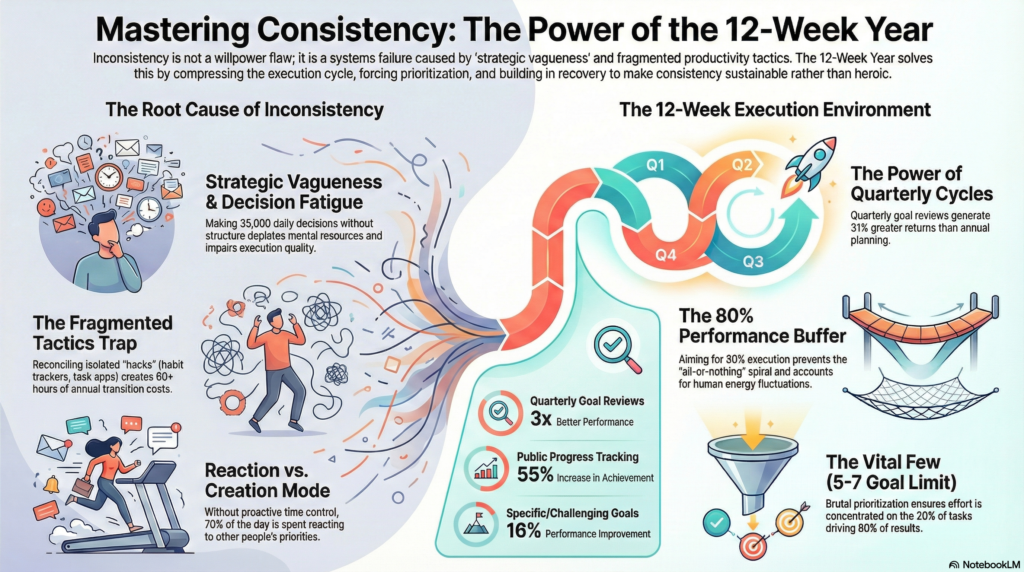
Research consistently validates this approach: setting specific, challenging goals leads to 16% improvement in performance, and over 90% of goal-setting studies confirm the positive effect of clear goals on performance.
What inconsistency looks like: You confuse activity with progress. You chase urgency, optics, and inbox-driven work. You spread effort across too many priorities, working hard but on low-impact tasks. Your results don’t reflect your effort because you’re busy but not effective.
I see this constantly with clients who come to me exhausted but unproductive. They’re working 60-hour weeks but accomplishing what should take 20 hours—because they’re doing everything instead of the right things.
What it looks like when you’re consistent: You proactively decide how time is spent. Priorities drive your day, not your inbox. You operate in “creation mode” rather than “reaction mode.” Your calendar reflects your goals, and you protect time for important work.
What inconsistency looks like: Your calendar, inbox, and notifications decide for you. You live in reaction mode, constantly pulled in multiple directions. You feel busy but directionless. Important work gets squeezed out by urgent work, and you end each day wondering what you actually accomplished.
The research is clear: without proactive time control, you spend roughly 70% of your day reacting to other people’s priorities rather than advancing your own. Studies show that decision quality deteriorates throughout the day, with judges’ favorable rulings dropping from 65% at the start of the day to nearly zero before breaks—demonstrating how accumulated decisions drain cognitive resources.
What it looks like when you’re consistent: You reliably do the important, uncomfortable work. Progress is steady and visible. You tackle friction instead of avoiding it. You execute on commitments regardless of difficulty, and you have a track record of completion.
What inconsistency looks like: You avoid friction and discomfort. You procrastinate on hard tasks, reshuffle them repeatedly, and wait for motivation before acting. You start strong but don’t finish. Your to-do list becomes a graveyard of abandoned commitments.
This is where most goal-setting systems fail. They tell you what to do but provide no mechanism for actually doing the hard work when resistance shows up.
What it looks like when you’re consistent: Your pace is repeatable week after week. You manage energy, not just tasks. You can maintain performance over months and years, building capacity over time. Work feels challenging but sustainable.
What inconsistency looks like: You sprint, burn out, recover, and restart. You call unsustainable effort “working hard.” Your performance peaks and crashes in waves. You can’t maintain intensity beyond short bursts, and productivity comes in waves rather than steady flow.
I’ve learned this the hard way. Early in my career, I operated at 110% until I hit a wall, took two weeks to recover, then repeated the cycle. It took me years to realize that sustainable 80% performance beats unsustainable 110% performance every single time.
What it looks like when you’re consistent: You enjoy the process overall. You feel purpose, meaning, ambition, and progress. Motivation emerges naturally because results are real. Work energizes more than it drains, and you experience compounding confidence.
What inconsistency looks like: Work feels heavy, random, and draining. You rely on willpower, hype, or guilt to move forward. You question whether what you’re doing matters. Effort feels disconnected from results, and you experience chronic doubt and decision fatigue.
This is the dimension most people ignore—but it’s critical. Without psychological momentum, every action becomes an act of willpower. With it, consistency becomes natural rather than forced.
Get the 12-Week Year template used by our team
Here’s what most productivity advice gets wrong: it treats inconsistency as a motivation problem. “Just be more disciplined.” “Build better habits.” “Try harder.”
But inconsistency isn’t a motivation problem. It’s a systems problem.
The primary reason people struggle with consistency is operating in what I call “strategic chaos”—a state where work lacks fundamental structure:
This vagueness creates massive cognitive and emotional friction:
Decision fatigue: Every morning you ask “What should I work on today?” This question—asked repeatedly—burns willpower before you even start working. Research published in Psychological Bulletin demonstrates that repeated decision-making depletes mental resources and impairs subsequent decision quality, with people making an average of over 35,000 decisions daily.
Chronic anxiety: You constantly wonder “Am I even working on the right things?” This low-level stress runs in the background, draining mental energy.
Procrastination: When direction is fuzzy, it’s easier to delay. Your brain resists unclear tasks.
Demotivation: Unclear results feel meaningless. When you can’t see progress, effort feels pointless.
Mental exhaustion: Your brain runs constant background processes trying to figure out priorities, eating up mental RAM you need for actual work.
Without a system, chaos compounds at every level:
Each level multiplies the chaos from the level above it. By the time you get to daily execution, you’re operating with 5x the uncertainty you started with.
Most people collect productivity “hacks” without a unified system:
These pieces don’t talk to each other. The result? You spend more time managing your management system than doing actual work.
Each tactic requires separate decision-making, tracking, and energy. You’re constantly switching frameworks and contexts. The pieces often work against each other instead of reinforcing. And transition costs—invisible but massive—add up to 60+ hours per year.
When I work with clients, this is almost always the pattern I see. They have seven different systems for seven different aspects of productivity. They’re exhausted from trying to reconcile all of them, and nothing is actually working.
The 12-Week Year isn’t just another productivity tactic. It’s a complete execution environment that addresses all six dimensions of consistency simultaneously through an integrated system.
Here’s how it works.
The 12-Week Year explicitly acknowledges you cannot perform at 100% all the time. The system is built around achieving 80% execution on your weekly commitments—which accounts for the reality that 20% of your time will be suboptimal due to bad days, slow weeks, or life disruptions.
This creates psychological safety. You’re not expected to be perfect. Recovery is faster because you’re not derailed by self-criticism after one off day. The all-or-nothing mentality that causes people to quit is removed.
The operational reality: someone with 80% execution on a clear plan massively outperforms someone with 100% effort on vague, reactive work.
The system also includes built-in energy management. The 13th week is explicit rest and recharge time. Weekly reviews prevent energy depletion from compounding. You work with your natural rhythms, not against them.
The 12-Week Year forces brutal prioritization through a hard constraint: maximum 5-7 goals per 12-week cycle.
This isn’t a suggestion—it’s a structural limit. You physically cannot load yourself with 15 goals. The constraint forces you to choose what creates disproportionate impact and eliminate or defer everything else. This aligns with the Pareto Principle (80/20 rule), which demonstrates that roughly 80% of results come from 20% of efforts—a pattern observed across business, economics, and productivity research.
But it goes deeper than just limiting goals. Every goal must connect directly to your long-term vision. The system forces you to define where you’re going before deciding what to work on. Goals aren’t random—they’re strategic stepping stones.
Research supports this shorter cycle approach: companies that review goals quarterly generate 31% greater returns than those who review goals annually, and quarterly goal reviews deliver 3x better performance than annual reviews.
Here’s the process:
Research on goal-setting theory demonstrates that goal clarity significantly enhances performance by reducing role ambiguity and increasing self-efficacy—when you know exactly what’s expected, the path to achievement becomes clearer.
When I implemented this with one client—a founder drowning in 23 competing priorities—we cut it to 5 goals. His team’s output tripled in the first cycle. Not because they worked harder, but because effort was finally concentrated on what actually moved the business forward.
Every week, you create a tactical plan derived directly from your 12-week goals. The plan specifies what actions to take and when to take them. Time blocks are allocated proactively based on priorities.
This eliminates decision fatigue. Big decisions (goals) are made once per 12 weeks. Medium decisions (weekly priorities) are made once per week. Daily execution simply follows the plan—minimal decisions needed.
Your brain no longer runs constant background processes:
The result: chronic low-level anxiety drops because uncertainty drops. Mental RAM is freed up for deep work. You can focus fully on execution. You can actually relax when not working because the plan will be there tomorrow.
The weekly plan includes dedicated time blocks for uncomfortable, high-value tasks. Hard work gets scheduled, not avoided.
Because vagueness and decision fatigue are eliminated, mental energy is freed up. You’re not depleted by figuring out what to do—just by doing it. Clarity removes one major source of resistance.
When you know the task is important (vision-aligned, goal-connected), psychological resistance decreases. Purpose creates pull, not just push.
The weekly scorecard tracks whether you did what you planned. You measure execution, not just outcomes. Hard tasks can’t hide—they’re visible in the plan and the review.
For clients who add peer or coach accountability, the effect multiplies. Research from Dominican University shows that sharing goals with others increases success rates to 70%, compared to only 35% for those who keep goals private. Social commitment activates deeper engagement. You build a track record of tackling friction, which compounds confidence over time.
The 12-Week Year includes multiple burnout prevention mechanisms:
Goal limits (5-7 maximum): The hard constraint prevents overcommitment. You physically cannot load yourself with 15 goals. Constraint creates focus, focus creates results.
80% performance buffer: The system doesn’t expect perfection. Pacing is sustainable because it’s designed for humans, not machines.
Weekly review process: Required reflection every week forces you to confront overload early. You ask: “Did I plan too much? Am I exhausted? What were the obstacles?” Adjustments happen weekly, not after 12 weeks of grinding.
12-week cycles with recovery: Every cycle ends with a full review and rest period (13th week). Time to decompress, reflect, and recharge before the next cycle. Intensity is high but time-limited—you can sustain it because there’s a finish line.
80/20 focus: Working on the vital few means you’re not wasting energy on low-impact work. Efficiency creates capacity—you get more done with less effort.
The system is designed for repetition—cycle after cycle, year after year. You don’t burn out and quit. You execute sustainably over the long term.
Every goal in the 12-Week Year ties back to your long-term vision. Work has meaning because you see the bigger picture. You’re not just checking boxes—you’re building toward something that matters. Intrinsic motivation emerges from alignment with personal values.
The weekly scorecard shows concrete progress (or lack thereof). You’re not guessing—you know if you’re winning. Seeing real results generates natural motivation. A meta-analysis of 138 studies involving nearly 20,000 participants found that monitoring goal progress significantly promotes goal attainment, with even larger effects when progress is physically recorded and reported publicly. Data replaces feelings as the source of truth.
And because 12 weeks is short enough to see meaningful change, progress becomes visible fast. Unlike annual goals where progress feels distant, you see traction quickly. Visible wins compound confidence and momentum. Each completed goal reinforces the belief that you can achieve more.
Weekly reviews create reflection and insight. End-of-cycle reviews produce deeper lessons. You get better at execution cycle after cycle. You’re not just achieving goals—you’re becoming an execution expert. Competence builds, which feels intrinsically rewarding.
After a few cycles, something profound happens: identity formation through repeated evidence. The weekly scorecard provides repeated proof of execution. You start to see yourself as “someone who follows through.” Behavior becomes congruent with identity. Self-trust compounds because you have proof you can deliver.
Watch This Short Video That Summarizes This Article:
Mastering Inconsistency With The 12-Week Year
Here’s what makes the 12-Week Year structurally superior to scattered productivity tactics: integration.
When you have isolated tactics—goal-setting from one place, time management from another, habit tracking from a third—each piece requires separate decision-making, tracking, and energy. You’re constantly reconciling different systems.
The 12-Week Year creates a closed-loop execution environment where every component feeds into the next:
This integration creates strategic coherence. All parts point in the same direction. Your daily actions trace directly back to your ultimate vision. There’s no strategic drift and no wasted effort on misaligned work.
It also creates workflow efficiency. You have zero reconciliation between different systems needed. There’s a single source of truth for what matters. Muscle memory builds around one process. Mental energy is saved for actual work instead of meta-work.
And the system becomes self-correcting. Feedback automatically improves execution. You’re never more than a week off course. Small deviations are caught within days, not months. Course corrections are minor adjustments, not major overhauls.
Start with your vision. Where do you want to be in 3 years? What does your ideal life look like? This provides the north star that makes every goal meaningful.
Choose 5-7 goals for your first 12-week cycle. Ask: “What would make the biggest impact toward my vision in the next 12 weeks?” Be ruthless. Everything else gets deferred.
Break each goal into weekly tactics. What specific actions will move each goal forward? These become your weekly commitments.
Plan every Sunday. Review last week’s scorecard. Plan next week’s tactics. Schedule them into your calendar as time blocks.
Track execution daily. Did you do what you planned? Simple yes/no. This becomes your weekly scorecard.
Review every Friday. What worked? What didn’t? What obstacles showed up? What needs to adjust?
Execute for 12 weeks, then take week 13 off. Full review. Rest. Plan the next cycle with lessons learned.
The first cycle will feel awkward. That’s normal. By cycle 2, patterns emerge. By cycle 3, it becomes automatic. By cycle 4, you’ll wonder how you ever operated without it.
For a full guide about the 12-Week Year, please explore our in-depth article.
Consistency isn’t achieved through motivation, discipline, or isolated tactics. It’s achieved through a complete, integrated system that:
The 12-Week Year addresses all six dimensions of consistency simultaneously. It removes the friction that makes consistency heroic and makes it achievable instead.
If you’re tired of starting strong and fading, tired of working hard without results, tired of the cycle of motivation and collapse—the problem isn’t you. The problem is operating without a complete system.
The 12-Week Year gives you that system.
They’re interconnected—weakness in any dimension undermines the others. However, if forced to choose, high-leverage direction (dimension 2) is foundational. Without clarity on what actually matters, you can show up consistently, control your time perfectly, and still accomplish nothing meaningful. The 12-Week Year’s 5-7 goal limit forces you to get this right first, which then makes the other dimensions easier to execute.
Strategic vagueness is operating without clear answers to fundamental questions. Example: You want to “grow your business,” but you haven’t defined whether that means revenue, profit margin, customer count, or market share. You don’t know which activities drive that growth. Your weekly plan is “work on marketing” without specifying which channels or campaigns. The vagueness creates decision fatigue because every day you’re re-deciding what to work on, burning mental energy before you even start.
No. The 80% refers to execution frequency, not effort intensity. You aim to complete 80% of your weekly commitments, not 100%. So if you plan 10 weekly tactics, hitting 8 of them is success. This accounts for the reality that some weeks are disrupted, some days are low-energy, and perfect execution is unsustainable. You still give 100% effort to the work you do—you just have permission to be human.
Because those pieces don’t talk to each other. Your goals live in one system, your time blocks in your calendar, your habits in an app. How do your goals inform your time blocks? How do your habits connect to outcomes? You’re constantly reconciling these systems manually, which burns cognitive energy. The 12-Week Year integrates all of this: goals → weekly plans → scheduled time blocks → tracked execution → measured outcomes. It’s one closed loop.
Through weekly planning derived directly from goals. Every Sunday (or your chosen day), you create a tactical plan for the week based on your 12-week goals. You schedule specific time blocks for specific actions. This means Monday morning, you don’t wake up asking “what should I work on?”—it’s already decided. Your calendar reflects your priorities, not just incoming demands. Decision fatigue is eliminated at the daily level because decisions were made once at the weekly level.
Integration premium means the system produces results greater than the sum of its parts. Example: Goal-setting alone gives you direction. Measurement alone gives you data. But when goals automatically inform weekly plans, which produce execution data, which triggers review insights, which refine next week’s plan—you get a self-correcting system. The feedback loops create emergent benefits (like momentum, clarity, adaptation) that no single tactic could produce. You get multiplicative returns instead of additive returns.
Your spreadsheet likely tracks outcomes (“Did I hit my goal?”). The 12-Week Year scorecard tracks execution (“Did I do what I said I would do this week?”). This distinction is critical. Outcomes are lagging indicators—you find out too late if you’re off track. Execution is a leading indicator—you know immediately if you’re executing the right behaviors. The scorecard also creates the psychological accountability that drives follow-through. Without it, you’re just hoping for results.
Motivation is an emotion that comes and goes. Psychological momentum is a compounding system effect. It emerges from: clear goals (meaning) + visible progress (proof) + repeated wins (identity reinforcement) + competence development (mastery). The 12-Week Year generates this through its structure—not through trying to feel motivated. After a few cycles, you show up because you have evidence you can deliver, not because you feel like it.
Strategic decision fatigue is productive; tactical decision fatigue is destructive. You make big decisions once (quarterly: what are my goals?) and medium decisions once per week (weekly: what tactics will advance those goals?). This uses decision energy wisely. The alternative—making small tactical decisions 10+ times daily with no clear framework—drains you constantly. The research cited shows that eliminating repeated daily decisions preserves cognitive resources for actual execution.
Four structural guardrails: (1) Goal limits prevent overcommitment—you can’t load 15 goals. (2) 80% buffer means bad weeks don’t break the system. (3) Weekly reviews catch burnout early before it compounds. (4) Week 13 is mandatory rest. The intensity is high but time-boxed—you know there’s a finish line. This is the opposite of annual goals where unsustainable grinding has no natural end point. The cycle structure creates healthy intensity-recovery rhythm.
Traditional goal-setting: set annual goals → vague progress → uncertain results → questioning yourself. 12-Week Year: clear goals → tracked weekly execution → visible scorecard data → completed cycles. Each week the scorecard gives you proof: “I executed 85% of commitments.” Each cycle gives you wins: “I achieved 4 of 5 goals.” After 3-4 cycles, you’ve accumulated hard evidence that you follow through. Your identity shifts from “someone who tries” to “someone who delivers.” That’s compounding confidence—built on evidence, not affirmations.
Strategic clarity is emergent—it doesn’t exist in any single component. Vision alone doesn’t give it. Goals alone don’t give it. But when vision informs goals, goals drive weekly plans, plans produce tracked actions, and actions generate feedback that refines the next week—strategic clarity emerges from the interaction. You suddenly know you’re working on the right things. This knowing can’t be forced; it emerges from the system functioning as a whole.
The meta-analysis cited showed that monitoring progress promotes goal attainment, especially when physically recorded and publicly reported. In the 12-Week Year, your weekly scorecard creates three momentum drivers: (1) Immediate feedback—you know instantly if you’re winning or losing. (2) Pattern recognition—after 4-8 weeks you see what’s working. (3) Proof accumulation—completed scorecards become evidence of capability. This generates intrinsic motivation because you’re seeing real results, not just hoping.
Without a system: small problems compound silently until everything breaks. With the 12-Week Year: weekly reviews catch issues within 7 days. Example: Week 3, your scorecard shows 50% execution. Red flag. Weekly review reveals you overplanned. Week 4, you adjust tactics. By Week 5, execution is back to 80%. The problem was corrected within 2 weeks, not after 12 weeks of failure. The feedback loops prevent small deviations from becoming catastrophic failures.
The goals provide stability; the weekly planning provides flexibility. Your 12-week goals are the strategic north star—they shouldn’t change unless something truly fundamental shifts. But your weekly tactics adjust every single week based on reality. Week 5 gets disrupted by a crisis? Your weekly review acknowledges it, and Week 6’s plan adapts. The goals stay fixed; the path to them adjusts weekly. This is how the system survives chaos while maintaining direction.
They’re the same idea applied at the goal level. The 80/20 principle (Pareto Principle) shows that 80% of results come from 20% of efforts. The 12-Week Year’s “vital few” constraint (5-7 goals max) forces you to identify that 20% before you start. Most people work on 15+ goals, diluting their effort. The goal limit ensures your effort is concentrated on the activities that will actually move the needle. It’s 80/20 thinking enforced by structure.
They’re interdependent. Example: without “high-leverage direction” (dimension 2), “showing up” (dimension 1) is wasted—you’re consistently working on the wrong things. Without “control over time” (dimension 3), “follow-through on hard things” (dimension 4) becomes nearly impossible—hard tasks get crowded out. Without “sustainable pace” (dimension 5), “psychological momentum” (dimension 6) eventually crashes from burnout. The 12-Week Year works because it addresses all six simultaneously rather than optimizing one while neglecting others.
Through the review process. End of each week: “What worked? What didn’t? What obstacles appeared?” End of each cycle (week 12): “Which goals succeeded? Which failed? Why? What would I do differently?” These reviews extract lessons that inform the next cycle. By cycle 3, you’re dramatically better at: (1) setting realistic goals, (2) accurate weekly planning, (3) identifying obstacles early, (4) knowing your capacity, (5) executing under pressure. The learning compounds because the system forces structured reflection.